
Are you looking for help designing commission plans for your new hires? You’ve found the right place! Simply put, a ramped quota is a progressive quota designed to accommodate a new role or new territory. In this blog post, we’ll discuss not only ramped quotas, but also other adaptations you can make to your incentive program to help new reps “ramp up”.
Regular Quotas vs. Ramped Quotas
Before discussing ramped quotas, let’s briefly discuss regular quotas – what they represent and how they are set.
Most organizations define commission quotas based on one of the following:
- The quota represents minimal expectations expected from reps OR
- The quota represents a informal, indicative goal (but without any impact on commissions) OR
- The quota represents an opportunity to earn accelerators or bonuses

One method to establish quotas is to examine the history of sales in a territory and make projections. Here is an example:
- The North East territory had $100,000 in sales last quarter
- We expect this territory to grow by 15% next quarter
- We will use $100,000 + 15% = $115,000 as a quota
Using this method to set quotas works well when the territory and associated reps (AEs, SDRs, etc.) remain more or less the same (i.e. there is some stability).
Another method to establish quotas is to examine the history of employee performance and make projections. Here is an example:
- SDRs in North America booked 30 customer appointments per month on average
- The best performing SDR booked 45 customer appointments
- The lowest performing SDR booked 22 customer appointments
- We expect a 10% improvement to those metrics because of new software
Using this method to set quota works well when dealing with experienced, fully trained SDRs.
However, both quota setting methods don’t quite work for situations where the territory or employee is new – examples:
- A new SDR has been hired for the North East territory
- This new SDR is still ramping up and needs time to build a deal pipeline
- A new product is being launched in the North East territory
- This product has not been sold before – how it will affect sales is unknown
- The North East territory is being split into two sub-territories
- It’s unclear what the quota should be because of way territories are being divided
- The North East territory is a brand new territory
- It’s difficult to estimate what sales may look like since there were no sales previously
For those cases (new rep or territory), it can make sense to use ramped quotas or a ramped commission plan structure.
Ramped Quota Examples
A ramped quota allows reps to “ramp up” using more progressive (gentler) goals. Typically, goals are set lower for ramping reps than for well-established ones. Ramping quotas may stay flat, or increase slowly.
Here are some examples of ramped quotas:
- SDRs normally have a quota of 30+ customer appointments per month. For new SDRs however, the following schedule will be used instead to allow them to ramp up:
- First month of employment = 10+ appointments
- Second month of employment = 15+ appointments
- Third month of employment = 20+ appointments
- AEs normally have a quota of $100,000 in revenue per month. For new AEs however, the following schedule will be used to allow them to ramp up:
- The quota is quarterly instead of monthly, to give AEs more time to ramp up
- The quarterly quota is 3x the monthly quota, reduced by 33%
Note the 3 different strategies employed to help reps ramp up:
- Reduce goals / quotas
- Make quotas more progressive
- Extend the period used to measure sales performance (ex: monthly quota > quarterly quota)
Avoiding Excessive Commissions
Consider a quota-based commission structure with accelerators such as this one:

The regular quota for AEs at 100% of attainment is $100,000. The commission rate doubles once quota has been retired. The commission rate is even higher when 150% of quota has been met.
It makes sense to lower quotas for ramping AEs – for example, from $100,000 to $50,000. After all, new reps have to learn about your company, understand products, introduce themselves to clients, etc.
However, if you misjudged the necessary reduction in quota, you could pay commissions at an excessive rate. To avoid excessive commissions, a ramped commission schedule may cap or remove accelerators.

In the example above, the quota is lowered from $100,000 to $50,000. There is still an incentive to double one’s commission rate by meeting 100% of quota. However, the higher commission rate (reserved for the highest achievers) no longer applies. This pattern is frequent in ramped quota structures. This is especially useful for ramping SDRs. Often, their count of booked appointments easily beats initial expectations.
Ramped Quotas vs. Draws
Another option is to keep full quotas, but offer a draw to your reps. In this case, you apply normal quotas, but provide a reasonable and temporary guarantee to your reps. For example:
- All new SDRs receive a $1000 draw – for 3 full months, starting from their hire date
- For example, if a new SDR earned $1200 in their first month, they keep their full commissions
- However, if a new SDR only earned $800 in their second month, they receive an additional $200
- This $200 draw amount can be either recoverable (to be repaid from future commissions) or non-recoverable (forgiven)
Same Plan or Different Plan?
Should you create different commission plans for ramping reps vs. non-ramping reps?
If the only difference in structure is a/ reduced quotas or b/ draws, then you could keep the same plan, which is then applied to both ramping and non-ramping roles. However, if you want to vary the frequency (monthly payout for regular AEs, quarterly payout for ramping reps), or use a different tier structure, then it makes more sense to create separate commission plans.
In this example, we’ve created 2 commission plans for AEs vs. ramping AEs, because their frequency is different (monthly vs. quarterly):
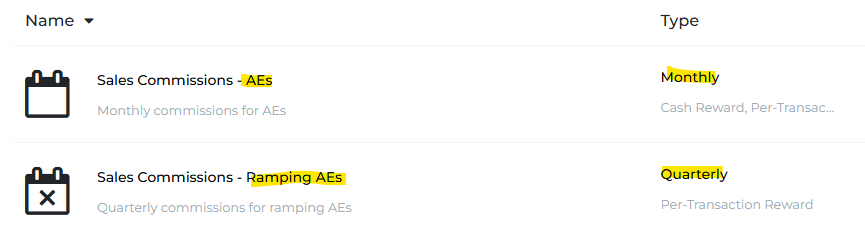
The AE plan has 3 tiers, with a cash bonus paid in the last tier at 150% attainment:

The AE Ramping plan only has 2 tiers, with a lower quota (the 3rd tier no longer exists):

In addition, the AE ramping plan has a recoverable draw of $1000, which the regular AE plan does not have:

Those differences are sufficient to justify creating a different plan for ramping AEs vs. regular AEs.
In Conclusion
New sales reps warrant making adjustments to commission structures. Key strategies include – ramped quotas, recoverable draws, extended commission periods, and rate capping. Sales Cookie can easily automate all commission rules, and help you easily manage plans and versions. We’d love to help!

 Sales Commissions Explained