Updated for 2026 · 12-minute read · Written by the team at Sales Cookie
Most articles about incentive compensation give you a long list of plan names and call it a day. That is not very useful when you are sitting in front of a blank spreadsheet trying to design something a sales rep, a CFO, and a board can all live with.
This guide takes a different approach. Instead of cataloguing plans alphabetically, we group every major type of incentive compensation by the behavior it actually drives, then show how to combine them. By the end, you will have a clear mental map, a comparison table, an at-a-glance decision matrix, and a checklist of mistakes to avoid before you launch a single plan in 2026.
TL;DR — the 60-second version
- Incentive compensation is any pay element that varies with results. Sales commissions are the most visible example, but bonuses, equity, gainsharing, SPIFFs, and recognition awards all qualify.
- Modern plans cluster into five archetypes: individual cash, group cash, long-term wealth, goal & milestone bonuses, and recognition / non-cash incentives.
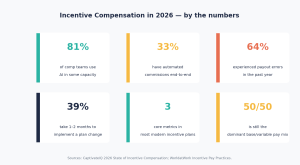
- The 50/50 base-to-variable pay mix is still the most common in B2B sales, but the trend in 2026 is fewer metrics per plan (typically three) and faster plan adjustments.
- Roughly 81% of comp teams now use AI in some capacity, but only a third of organizations have automated commissions end-to-end — which is exactly where most leakage and shadow accounting come from.
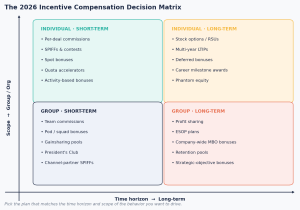
- The right plan is the one that matches the time horizon and scope of the behavior you want to drive. Use the matrix below as a starting point.
What we mean by “incentive compensation” (and what we don’t)
Incentive compensation is the portion of pay that is contingent on an outcome. If a payment goes out regardless of performance, it belongs to base salary, benefits, or allowances — not incentive comp.
That distinction matters because it determines accounting treatment, motivational pull, and how easily a plan can be modeled. A few quick framings we will use throughout the article:
- Variable pay vs. base pay. Together they form on-target earnings (OTE). The split is your “pay mix.”
- Direct vs. indirect. A direct incentive (cash, equity) hits the wallet; an indirect one (recognition, trips, training budget) shapes culture.
- Individual vs. shared. Some plans pay one person; others pay a pod, region, or the whole company.
- Short-term vs. long-term. SPIFFs and monthly commissions live on one end; LTIPs, options, and ESPPs live on the other.
If you want a deeper structural view of how a plan actually gets calculated under the hood, our companion piece Deconstructing Sales Commission Software breaks the math into five steps (filter, valuate, credit, attain, payout).
The 2026 incentive compensation decision matrix
Before we list plans, look at the matrix. Two questions almost always determine which type of plan you should reach for:
- How long is the behavior horizon? Are you nudging a quarter, or rewarding three years of strategic work?
- How wide is the audience? Is the outcome owned by one rep, or by an entire team, region, or company?
The five archetypes of incentive compensation
Once you have a quadrant in mind, picking the actual plan type gets a lot easier. Here are the five archetypes that, between them, cover virtually every modern incentive plan.
1. Individual cash plans (the workhorses of B2B sales)
This is what most people think of as “sales commission.” The reward is cash, the audience is one person, and the cycle is short — usually monthly or quarterly. The variants you should know in 2026:
- Straight (per-deal) commission. A flat percentage on every closed deal. Easy to understand, easy to game; best for high-velocity, transactional sales.
- Tiered & accelerated commissions. The rate climbs as attainment grows. Above 100% of quota, accelerators of 1.5x–3x are typical and align nicely with the “10% of reps drive 50% of new bookings” pattern. Try our tiered commission calculator if you want to model blended rates across tier boundaries.
- Quota-based bonus. A lump sum paid for hitting a number — typical for sales managers and roles where pipeline lag makes per-deal commissions volatile.
- Draw against commission. A predictable advance that gets reconciled against actual commissions. Useful during ramp, dangerous if “non-recoverable” without guardrails.
- SPIFFs (Sales Performance Incentive Funds). Time-boxed pushes — for example, “double commission on Product X for the next 60 days.” Powerful, but easy to over-use; if SPIFFs run constantly they stop feeling special.
- Margin- or profit-based commissions. Pay scales with the deal’s profitability, not just its top-line revenue. This is what stops reps from discounting their way to quota; we walk through the mechanics in Advanced Profit-Based Commission Calculations.
2. Group cash plans (when collaboration matters more than heroics)
Use these when the outcome is genuinely shared — implementation pods, customer success squads, channel ecosystems — or when you want to reduce the “lone wolf” behavior that pure individual plans can encourage.
- Team / pod commissions. A pool that gets split across the squad based on role weights or equal shares. Common with hunter–farmer pairs and AE+SE+CSM pods.
- Gainsharing. Employees share in productivity gains that exceed a baseline. Born in manufacturing but increasingly used in operations, support, and customer success teams.
- Profit sharing. A percentage of company profit gets distributed by formula. Good for mature, stable businesses; less effective for early-stage teams where profit can be volatile or negative.
- Channel-partner SPIFFs and MDF programs. Cash, market-development funds, or co-branded campaigns paid to resellers and distributors. Often overlooked, but it is still incentive compensation — and it deserves the same governance as internal plans.
- President’s Club and ranked contests. Cash + experiential reward (the trip is the headline). Behaviorally powerful because public ranking adds status to dollars.
3. Long-term wealth plans (for leaders, key hires, and culture-building)
These plans are designed to hold people to a multi-year arc. They rarely move week-to-week behavior, but they are the difference between a great hire who leaves at year two and one who stays for the strategic payoff.
- Stock options & RSUs. Direct equity ownership with a vesting schedule (typically four years with a one-year cliff). Powerful at startups; still useful at public companies via RSUs.
- Employee Stock Purchase Plans (ESPPs). Discounted purchase of company stock, usually via payroll deduction. Inclusive of the whole workforce, not just executives.
- Long-Term Incentive Plans (LTIPs). Multi-year cash or stock awards tied to strategic metrics — revenue CAGR, EBITDA targets, or relative TSR vs. a peer group.
- Phantom equity / SARs. Cash payments that mirror equity value without diluting ownership. Good for private companies that don’t want to issue real shares.
- Deferred bonuses & clawbacks. A portion of an annual bonus pays out 12–36 months later, contingent on continued employment or sustained performance. Strong retention tool; also useful for compliance with revenue-recognition standards.
4. Goal & milestone bonuses (for non-sales and project-driven roles)
Not everyone closes deals, but everyone has objectives. This archetype is how you bring incentive comp to engineering, marketing, product, finance, and operations without forcing a fake “commission” onto them.
- MBO (Management by Objectives) bonuses. A small set of agreed-upon objectives, scored at period end. Each objective has a weight and a target.
- Project / milestone bonuses. A lump sum tied to a deliverable shipping on time and on spec — common in implementation, R&D, and IT.
- KPI-linked bonuses. Pay scales with a specific metric (NPS, retention, gross margin, on-time delivery) the role can directly influence.
- Revenue-influenced bonuses. A cousin of MBO that ties part of the bonus to a global outcome (e.g., company ARR or pipeline coverage), so non-sales teams stay aligned with the revenue engine.
5. Recognition & non-cash incentives (the secret weapon)
Behavioral research consistently shows that timely, public, and personal recognition can deliver more motivational lift per dollar than cash. The catch is that you have to actually give it — and most organizations are bad at that.
- Spot bonuses and gift cards. Small, immediate, often manager-discretionary. Use sparingly so they retain meaning.
- Experiential rewards. Trips, dinners, premium tickets. Memorable in a way that a wire transfer is not.
- Public recognition. Slack shout-outs, all-hands callouts, leaderboard placements. Costs nothing; matters more than people admit.
- Career-capital rewards. Conference budgets, certifications, mentorship time with executives, paid sabbaticals. Especially strong for engineering and high-skill roles.
- Choice-based catalogs. Let employees pick from a menu (charitable donation, extra PTO day, equipment upgrade). Choice itself is motivating.
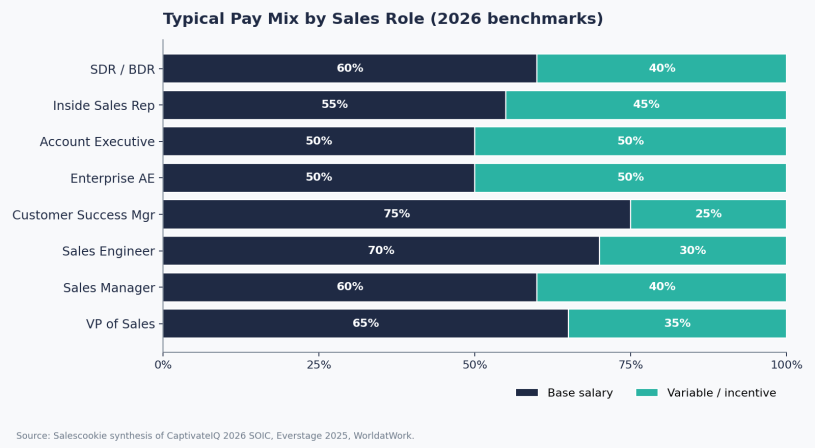
Pay mix by role: how the archetypes show up in practice
The archetype matters, but so does the dose. Roles closer to the deal carry more variable pay; roles further from the deal carry more base. Here is a rough 2026 benchmark to sanity-check your plan against.
Comparison table: which plan fits which situation?
Below is a side-by-side cheat sheet. Use it as a starter; calibrate the numbers against your industry’s typical commission rates and your unit economics before launch.
| Plan type | Archetype | Best for | Time horizon | Typical payout vehicle | Watch out for |
|---|---|---|---|---|---|
| Straight commission | Individual cash | High-velocity AEs, transactional sales | Monthly | % of revenue | Discount-driven behavior |
| Tiered / accelerated commission | Individual cash | Quota-carrying reps | Monthly / quarterly | Stepped % | Tier “boundary gaming” |
| Quota-based bonus | Individual cash | Sales managers, long-cycle roles | Quarterly | Lump-sum cash | Cliff effects near 100% |
| Draw against commission | Individual cash | Ramping reps, new territories | Monthly | Recoverable / non-recoverable advance | Underwater reps disengage |
| SPIFF | Individual cash | Product launches, end-of-quarter pushes | Days to weeks | Cash bonus or kicker rate | SPIFF fatigue |
| Margin / profit commission | Individual cash | Configurable products, services | Monthly | % of margin | Cost-data accuracy |
| Team / pod commission | Group cash | AE+SE+CSM pods, customer-success squads | Quarterly | Pool split by role weight | Free-rider risk |
| Gainsharing | Group cash | Operations, support, manufacturing | Quarterly | Share of productivity gain | Baseline drift over time |
| Profit sharing | Group cash | Mature, profitable businesses | Annual | Pool % of profit | Volatile in down years |
| Channel SPIFF / MDF | Group cash | Resellers, distributors | Quarterly | Cash + market funds | Audit / compliance |
| President’s Club | Group cash + experiential | Top 5–10% of reps | Annual | Trip + cash bonus | Demotivates the middle 60% |
| Stock options / RSUs | Long-term wealth | Startups, key hires | 3–4 years vesting | Equity | Strike price > FMV |
| ESPP | Long-term wealth | All employees at public companies | 6-month windows | Discounted shares | Plan complexity for payroll |
| LTIP | Long-term wealth | Executives, succession candidates | 3–5 years | Performance shares / cash | Goal staleness |
| Phantom equity / SARs | Long-term wealth | Private companies avoiding dilution | Multi-year | Cash mirroring equity | Liquidity pressure on company |
| Deferred bonus | Long-term wealth | Retention-sensitive roles | 1–3 years | Cash with vesting / clawback | Communication clarity |
| MBO bonus | Goal & milestone | Managers, customer success, ops | Quarterly / annual | Weighted objective scorecard | Subjective scoring |
| Project / milestone bonus | Goal & milestone | Engineering, R&D, implementation | Project-bound | Lump sum on delivery | Scope creep |
| KPI-linked bonus | Goal & milestone | Functional teams (NPS, retention, GM%) | Quarterly | % of base × KPI score | Single-metric tunnel vision |
| Spot / on-the-spot bonus | Recognition | Ad-hoc behaviors and culture wins | Days | Cash, gift card | Manager bias / favoritism |
| Experiential reward | Recognition | Top performers, milestone moments | Annual | Trips, events | Tax treatment |
| Career-capital reward | Recognition | Engineers, high-skill ICs | Ongoing | Budget, certifications, sabbaticals | Underused if not promoted |
How to actually pick a plan: a five-question filter
Generic frameworks tend to read like “align with goals, communicate clearly.” Useful sentiment, useless decision tool. Here are five questions that genuinely narrow the field:
- Who controls the outcome? If the answer is “one rep,” choose an individual plan. If it’s “a pod” or “the company,” choose a group plan. If both, run two plans.
- Over what time window does the behavior compound? A monthly cycle calls for commissions and SPIFFs. A multi-year strategic bet calls for LTIPs, equity, or deferred bonuses.
- Can the metric be measured cleanly and quickly? If not, you will burn trust. A KPI bonus on a metric your finance team can’t reconcile within five business days is a future dispute, not a plan.
- What is the worst-case payout if everyone wins? Run the numbers at 120%, 150%, and 200% attainment. If those scenarios bankrupt the plan, add caps, decelerators, or move to a bonus pool.
- Will a rep be able to explain the plan to their spouse in two sentences? If not, simplify. The 2026 trend is three core metrics, not five or six, and that is for a reason.
Common 2026 pitfalls to avoid
Across the hundreds of incentive structures we automate, the same mistakes show up over and over. Watch for these.
- Shadow accounting. When reps don’t trust the system, they keep their own spreadsheet — and you lose 60+ hours of productive selling time per rep per year. The fix is transparent statements with audit trails, not a sterner email about “trusting the process.”
- Plan inflation. Every quarter someone adds another bonus, kicker, or special metric. After two years the plan is unintelligible. Sunset old components when you add new ones.
- The “January 1” rewrite trap. Big-bang annual rewrites concentrate risk. Shift to quarterly tuning — small changes, high cadence, A/B-able where possible.
- Treating non-sales like sales. Forcing engineering or CS into a “commission” model rarely works. Use MBO or KPI bonuses for them and keep commissions for the people whose effort directly closes deals.
- Forgetting clawbacks. If a deal cancels in month two, the commission should claw back. Plans without clawback math leak revenue and create accounting headaches under ASC 606.
- Manual overpayment errors. Across the SMB sales orgs we’ve surveyed, an average of 4.2% of payouts get later identified as overpayments. That’s a six-figure leak at moderate scale, almost always traceable to spreadsheet errors.
How automation changes the picture in 2026
Here is the uncomfortable truth most “types of incentive compensation” articles skip: the type of plan you choose matters less than whether you can actually run it cleanly at scale. A perfect plan calculated incorrectly is worse than a simple plan calculated right.
That is what makes 2026 different. AI and automation have collapsed the cost of running sophisticated plans, which means the smart move is no longer “design the simplest plan you can compute.” It’s “design the plan that drives the right behavior, then automate the math out of human hands.”
A few capabilities are now table-stakes:
- End-to-end calculation across all reps in a single click, including tier blending, splits, and clawbacks.
- Time-dependent variables for quotas, rates, and territories (so mid-period role changes don’t break the math).
- Per-rep online statements with full audit trails, replacing the email-the-spreadsheet ritual.
- CRM and accounting integrations that pull sales data directly — Salesforce, HubSpot, QuickBooks, Xero, and so on. See the setup overview for the typical onboarding flow.
- A documented plan-design methodology you can hand to new admins; we maintain ours in The Ultimate Guide to Sales Commission Design.
If you are debating whether to build vs. buy, ask whether your team really wants to maintain a calculation engine in 2026 — or whether they would rather spend that energy on plan strategy.
FAQ
What is the difference between incentive compensation and a bonus?
A bonus is one form of incentive compensation. The umbrella term covers commissions, bonuses, equity, gainsharing, SPIFFs, recognition awards, and any other pay element that varies with results.
How many incentive plans should one company run?
Most well-run B2B sales orgs end up with 2–4 active plans: a primary commission plan, an LTIP or equity plan, an MBO/KPI plan for non-sales roles, and an ad-hoc SPIFF/recognition program. Running more than that usually means you have not retired old plans.
What is the typical commission rate?
It varies wildly by industry and product margin. As a rough range, software AEs run 5–10% of new ARR, services delivery often runs 1–5% of revenue, and channel-partner SPIFFs can range from 2% to 20% on strategic launches.
Are spot bonuses taxable?
In the US, yes — they are treated as supplemental wages and subject to standard payroll withholding. Gift cards are generally taxable too, even when small.
How do I avoid overpayments?
Three practices: (1) reconcile every payout against a system of record, (2) require dual approval before release, and (3) run a quarterly true-up that includes clawbacks. Automating the math removes the most common source of overpayments — manual spreadsheet errors.
The takeaway
There is no “best” type of incentive compensation. There is only the best fit for the behavior, audience, and time horizon you are trying to influence. Use the matrix to pick the quadrant, the comparison table to pick the specific plan, and the five-question filter to stress-test it before launch. Then — most importantly — automate the calculation so the plan you designed is actually the plan that gets paid.
Want help putting any of this into practice? You can explore Sales Cookie, browse implementation tips in our support knowledge base, or reach out for a walk-through of the platform. We have automated incentive plans for everyone from two-person consultancies to publicly traded manufacturers, and we are happy to share what works.
Selected sources and further reading: WorldatWork — Incentive Pay Practices; Mercer / WorldatWork — 2025 Salary & Incentive Survey.
 Sales Commissions Explained