Reading time: about 12 minutes. A practical 2026 guide to the federal and state wage laws that govern sales commissions in the United States: FLSA exemptions, “earned” commissions, written plan requirements, termination timing, and the eight states where getting this wrong is most expensive.
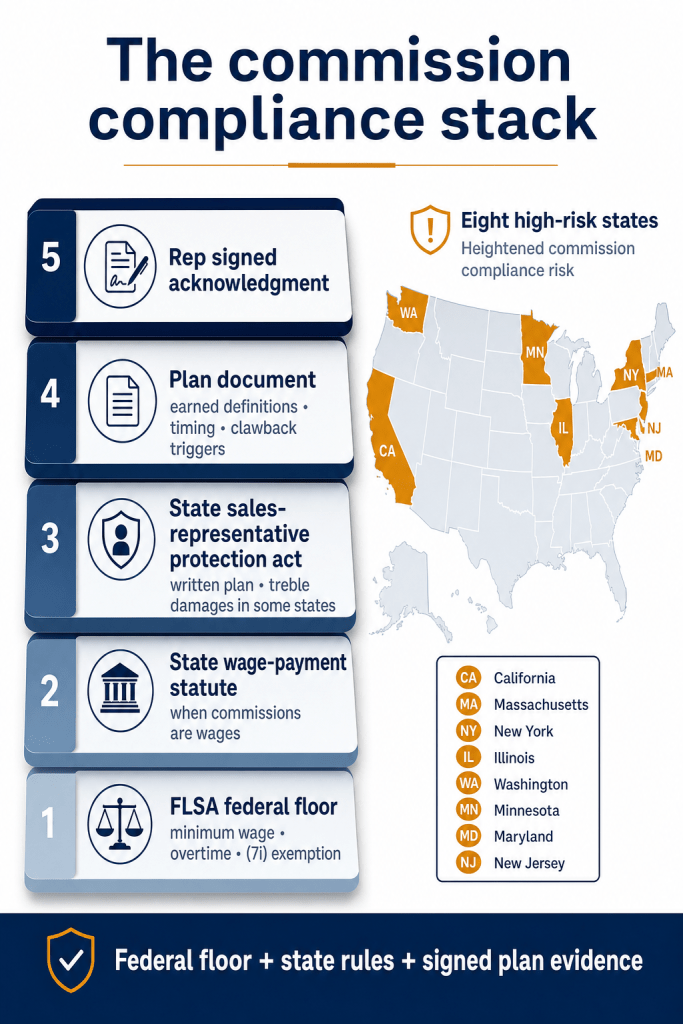
Sales commissions look like a compensation topic. Legally, they are a wage-and-hour topic, and the people who treat them as pure comp design are the ones who end up in the deposition. Federal law (the Fair Labor Standards Act) sets the floor on overtime and minimum wage. State law fills in almost everything else: when a commission is “earned,” whether it must be in writing, how quickly it must be paid after termination, and whether a post-hoc clawback is legal at all. Those state rules diverge sharply, and the divergence has been getting wider as more states pass sales representative protection acts and post-employment wage rules.
This article walks through the compliance framework that a US-based sales operations or finance leader should be able to explain in a room with legal counsel. It is not legal advice. It is the map you use to know which questions to ask.
The federal floor: what FLSA actually says about commissions
The Fair Labor Standards Act is the federal wage-and-hour law administered by the US Department of Labor. It sets the federal minimum wage, the 40-hour overtime threshold, and a set of exemptions. Two of those exemptions matter for commissioned sales roles.
The outside sales exemption covers employees whose primary duty is making sales and who are customarily engaged away from the employer’s place of business. Outside sales reps are exempt from federal minimum wage and overtime. The exemption is narrow. Inside sales, remote sales, and hybrid roles usually do not qualify.
The section 7(i) exemption covers certain retail and service establishment employees whose regular rate exceeds 1.5 times the federal minimum wage and where more than half of compensation in a representative period comes from commissions. Section 7(i) applies to overtime only, not minimum wage, and applies only to defined retail or service industries. Most B2B SaaS or professional-services sales roles do not fall inside 7(i).
If neither exemption applies, the sales rep is entitled to federal minimum wage for every hour worked and overtime at 1.5 times the regular rate for hours over 40 in a workweek. The regular rate includes non-discretionary commissions, which forces a retroactive true-up in the pay period when the commission is paid or reasonably ascertainable. Employers who assume “commissioned means overtime-free” without checking the exemption carefully are the ones who end up owing years of overtime plus liquidated damages.
State wage-payment statutes: when a commission becomes a “wage”
Every state has a wage-payment statute. Most define “wages” to include earned commissions. The consequence is significant. Once a commission is a wage under state law, the state’s rules on pay frequency, final paycheck timing, unauthorized deductions, and penalties for late payment all apply. Many states impose double or treble damages, attorneys’ fees, and personal liability on officers or managers.
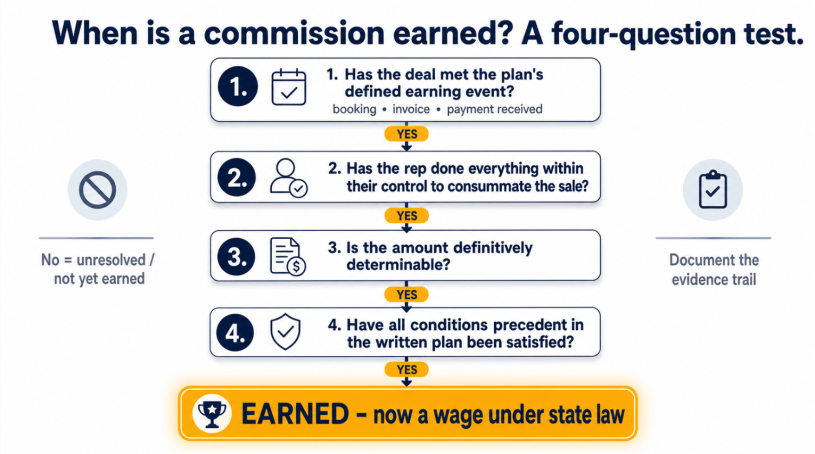
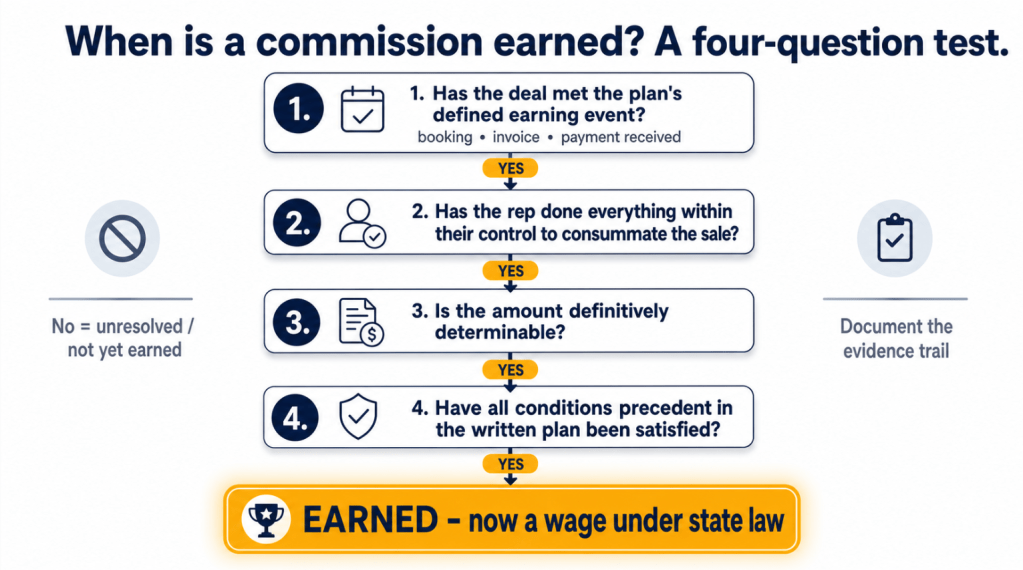
The pivotal question in almost every commission dispute is when is the commission “earned”? The plan document must answer this precisely, and the state’s default rule fills the gap when the plan does not. Some states will read ambiguity against the employer. California courts, for example, look at whether the rep has done everything within their control to consummate the sale.
The eight states where getting this wrong is most expensive
| State | Key Rule | Requirements | Penalty |
|---|---|---|---|
| California | Labor Code section 2751; Labor Code 201-203 | Written commission contract required for any employee whose pay includes commissions. Employer must give the rep a signed copy and get their signed acknowledgment. Final wages including earned commissions due at termination. | Waiting-time penalties up to 30 days of wages plus PAGA claims. |
| Massachusetts | Wage Act (Mass. Gen. Laws c. 149 s. 148) | Commissions “definitely determined” and “due and payable” are wages. Late payment triggers mandatory treble damages. | Automatic 3x damages plus attorneys’ fees. Personal liability for company president and treasurer. |
| New York | Labor Law 191, 191-c (Sales Rep Act) | Commission-only sales reps must have a written agreement. Post-termination commissions due within five business days after they become earned. | Double damages under 191-c; 100% liquidated damages under 198. |
| Illinois | Sales Representative Act (820 ILCS 120); Wage Payment and Collection Act | Independent sales reps’ commissions due within 13 days of termination. Employees’ earned commissions are wages under the WPCA. | Exemplary damages up to 3x unpaid commissions plus fees under the Sales Rep Act. |
| Washington | RCW 49.48; RCW 49.52 | Willful failure to pay wages is a misdemeanor. Earned commissions are wages once determinable. | Double damages, criminal exposure for willful non-payment. |
| Minnesota | Minn. Stat. 181.145 (Sales Rep Termination) | Commissions earned before termination due within three working days for a terminated rep, six working days for a rep who resigns. | Penalty of up to 15 days’ commissions plus civil penalties. |
| Maryland | Maryland Wage Payment and Collection Law (Lab. and Empl. 3-501 et seq.) | Earned commissions are wages. Bona-fide disputes cap penalties, but “bona fide” is a jury question. | Up to 3x damages plus attorneys’ fees. |
| New Jersey | N.J.S.A. 34:11-4.1 et seq. (Wage Payment Law, 2019 amendments) | Commissions are wages. 2019 amendments doubled the liquidated-damages exposure and lengthened the statute of limitations to six years. | Up to 200% liquidated damages plus attorneys’ fees. |
Two things stand out from the table. First, seven of the eight states impose some form of enhanced damages on top of the unpaid commission itself. A missed $50,000 payout in Massachusetts is a $150,000 exposure once you add mandatory trebling. Second, in California and New York, the written plan document is not optional. Operating a commission program in these states without a signed plan is a compliance failure regardless of whether anyone has complained yet.
Written plan requirements: what must be in the document
California Labor Code section 2751 is the strictest of the written-plan statutes and a reasonable template for national plans. It requires that the plan document set forth the method by which the commissions will be computed and paid. Case law and Division of Labor Standards Enforcement (DLSE) guidance have expanded this into a practical checklist.
| Required element | Why it matters |
|---|---|
| Definition of a “sale” and the earning event | Removes ambiguity about whether booking, invoicing, or cash receipt triggers the commission. |
| Formula (rate, tiers, accelerators, decelerators) | A rep must be able to calculate their own commission from the document alone. |
| Attainment period and reset rules | Monthly, quarterly, annual, or year-to-date. Silence favors the rep. |
| Splits, overrides, and team crediting | Splits are the single largest source of commission disputes when unwritten. |
| Clawback triggers and mechanics | A retroactive deduction that is not in the plan is generally not enforceable. |
| Payment timing | Must be at least as generous as the applicable state minimum for pay frequency. |
| Effect of termination | “Must be actively employed on payout date” clauses have been struck down in several states. |
| Dispute-resolution process | Internal appeal steps and timelines. Waives nothing but shows good faith. |
| Signed acknowledgment | California requires a signed copy on file. Best practice elsewhere. |
Clawbacks: legal, but only if the plan says so first
A clawback recovers commissions after the customer churns, cancels, refunds, or fails to pay. Clawbacks are enforceable in most states if three conditions are met. First, the trigger is defined in the plan document before the commission is paid. Second, the earning event in the plan is tied to something reversible (invoiced revenue rather than booking). Third, the mechanism does not push the rep below the applicable state minimum wage in any pay period.
Common mistakes: retroactively adding a clawback clause after a payout; deducting a clawback in a single pay period when it drops the rep below minimum wage; applying clawbacks to commissions that were earned under a prior plan year; and applying clawbacks in states with strict deduction rules like California without a written wage-deduction authorization.
Payment timing at termination: the trap most companies fall into
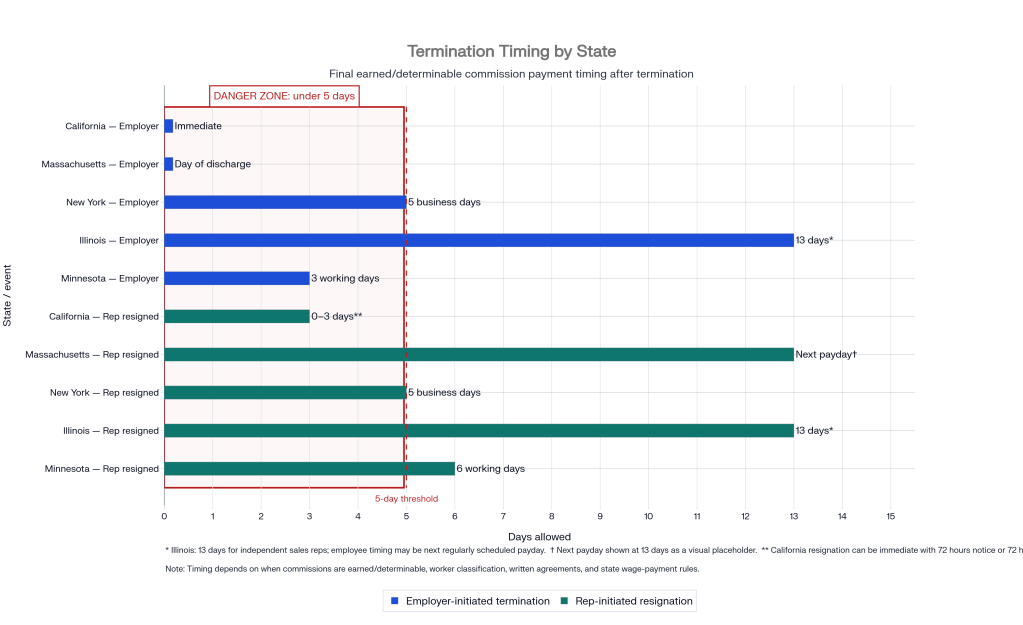
Termination is where most wage-payment claims originate, because it is the moment a rep suddenly has an incentive to look hard at their commission history. State rules on final paycheck timing vary from “same day” to “next regular payday,” but the tighter rules almost always apply to earned commissions.
| State | Employer-initiated termination | Rep-initiated resignation |
|---|---|---|
| California | Immediately at termination for all earned wages including determinable commissions. | 72 hours if no notice; immediately if 72 hours’ notice given. |
| Massachusetts | Day of discharge. | Next regular payday. |
| New York | Five business days after commissions become earned (191-c). | Five business days after commissions become earned. |
| Illinois | Next regularly scheduled payday; 13 days for independent sales reps. | Same as above. |
| Minnesota | Three working days for commissions. | Six working days for commissions. |
The subtle risk is the “determinable” commission. If a commission was earned during a rep’s tenure but the final amount depends on invoicing that happens after termination, most states still require payment within the state’s post-termination window once the amount becomes determinable. Simply telling a departing rep “we will pay you at the next quarter close” is often a violation.
Documentation and audit trail: what a labor attorney will ask for
In any commission dispute or wage-and-hour audit, the same eight artifacts get requested. If they exist, are consistent, and are easy to produce, most disputes end quietly. If they do not, the outcome is usually a settlement or judgment against the employer.
- The signed plan document for each plan year the rep worked under.
- Signed acknowledgments from the rep for each plan year.
- The source data (CRM opportunities, invoices, cash receipts) that fed each payout.
- The calculation record showing how each transaction was credited, tiered, split, and totaled.
- Approval records for each payout, with timestamps and approver identity.
- The rep’s statements for every period, showing the amount, the calculation basis, and any adjustments.
- Records of any manual adjustments, with a reason code and approver.
- Communication about plan changes, especially retroactive ones.
A commission platform that stores these artifacts by design is often the single largest reduction in wage-and-hour legal risk that a growing company will make. See our inside a crediting engine piece for the calculation-level detail, and our retroactive corrections and true-ups piece for how adjustments should be captured and approved.
Non-competes, non-solicits, and commission forfeiture
Some plans attempt to forfeit earned commissions if a rep leaves and violates a non-compete or non-solicit clause. State attitudes toward this range from “generally enforceable if reasonable” to “unenforceable and a wage violation.” California, Minnesota (as of the 2023 statute), and North Dakota void most non-competes outright. Massachusetts limits non-competes to 12 months and requires garden-leave pay. The FTC’s 2024 non-compete ban was vacated in federal court in 2024, so the current national landscape is a state-by-state patchwork as of June 2026.
Regardless of the underlying restrictive covenant’s enforceability, using commission forfeiture as the enforcement mechanism creates a separate wage claim in most states. If the commission was earned before the alleged breach, the general rule is that it is a wage and cannot be forfeited.
The five-item compliance checklist
- Do we have a signed written plan for every commissioned employee? California requires it. Every other state benefits from it.
- Does the plan clearly define when a commission is “earned”? If not, state default rules will fill the gap, usually in the rep’s favor.
- Are our clawback and forfeiture clauses grounded in the plan document, not added later? Retroactive changes almost never survive.
- Do our termination workflows honor state-specific timing? California’s “same day” and Minnesota’s “three working days” are the tightest.
- Can we reproduce the calculation, source data, and approval trail for any historical payout in under an hour? This is the difference between “we win the audit” and “we settle.”
What to do next
Compliance in sales commissions is not primarily a legal problem. It is an operational one. The legal exposure exists because most companies cannot produce the plan, the calculation, and the approval trail on demand. A well-designed commission platform captures all three by default, alongside every rep’s signed acknowledgment, every manual adjustment, and every plan version. When a dispute or audit lands, the answer is a report, not a scramble. If you want a walkthrough of how Sales Cookie handles the plan document, signed acknowledgments, calculation history, and adjustment audit trail, book a 30-minute demo and we will show you the specific artifacts a labor attorney is most likely to request.
Related reading
- The complete guide to sales commission clawbacks
- Real commission nightmares: case studies
- Sales commission disputes: anatomy and prevention
- Retroactive corrections and true-ups
- Inside a crediting engine
- How to assess your commission setup
Sources and notes
- US Department of Labor, Fair Labor Standards Act overview and Fact Sheet #20 on outside sales.
- California DLSE, FAQ on commissions; California Labor Code section 2751 and 201-203.
- Massachusetts Attorney General, Wage and Hour information; Wage Act analysis in Reuter v. Methuen (Mass. 2022).
- New York Department of Labor, Frequency of Pay guidance; Labor Law 191 and 191-c.
- Illinois Sales Representative Act (820 ILCS 120) and Wage Payment and Collection Act (820 ILCS 115).
- Minnesota Statutes section 181.145; Minnesota non-compete ban effective July 1, 2023.
- New Jersey Wage Payment Law amendments (P.L. 2019, c. 212) doubling liquidated damages.
- FTC non-compete rule and its 2024 vacatur in Ryan LLC v. FTC, as of June 2026.
- This article is general information, not legal advice. Consult employment counsel for state-specific plan review.

