Reading time: about 10 minutes. Commission statements are the single most-read document any rep receives from their employer. This is what belongs on one, what belongs off, how to structure the file, and the six failure modes that turn a statement from a trust-builder into a dispute-generator.
The commission statement is where the entire compensation program touches the ground. Every plan design decision, every quota model, every crediting rule, every SPIF layer, and every manual adjustment eventually shows up as a line on a document a rep opens between coffee and their first meeting. If that document is clear, the rep goes back to selling. If it is not, the rep opens a spreadsheet, starts shadow-accounting the numbers themselves, and the finance team’s phone starts ringing.
Companies spend enormous energy on plan design and almost none on statement design. This is backwards. A great statement papers over some plan flaws. A poor statement undermines even a perfect plan. This article lays out the anatomy of a great commission statement, the mandatory versus optional fields, delivery best practices, and the six ways statements go wrong.
What a great commission statement actually contains
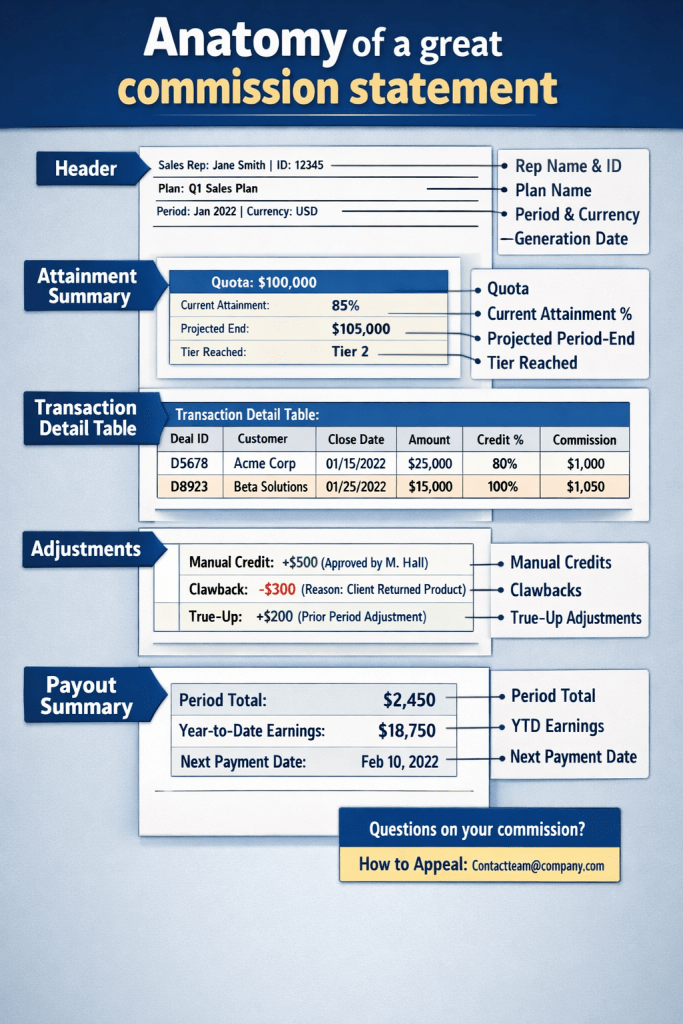
A rep should be able to answer four questions from the statement alone, without opening any other system: (1) What am I being paid this period and why? (2) How am I tracking against my quota? (3) Which deals count toward the payout, and how much did each contribute? (4) If I disagree with something, what do I do next?
Those four questions map to the five regions in the anatomy image above. Below is the field-level checklist that finance and sales-ops teams should use when specifying (or auditing) their statement design.
| Region | Mandatory fields | Recommended additions |
|---|---|---|
| Header | Rep name, employee ID, manager name, plan name, plan version, period start/end, currency, generation timestamp | Link to signed plan document; contact address for disputes |
| Attainment summary | Assigned quota, credited amount, attainment %, applicable tier, tier boundaries | YTD attainment, prior-period attainment for context, projected period-end |
| Transaction detail | Deal ID, customer, close date, deal amount, credit basis (revenue, ACV, margin), split %, rate applied, commission earned | Product mix, region, source system link (CRM opp URL), split partner names |
| Adjustments | Each adjustment as a line: type (SPIF, MBO, manager override, clawback, true-up), amount, reason code, approver, effective date | Link to the adjustment audit-trail entry; original transaction reference for clawbacks |
| Payout summary | Total period payout, YTD earnings, expected payment date, appeal window and process | Pay history graph, next-period preview, capping status if applicable |
The single most important word in that table is “why.” Every number the rep sees should be traceable to a rule in the plan document and a source transaction in the CRM or billing system. When the “why” is missing, the rep fills it in themselves, usually less favorably to the employer.
Delivery cadence and channel
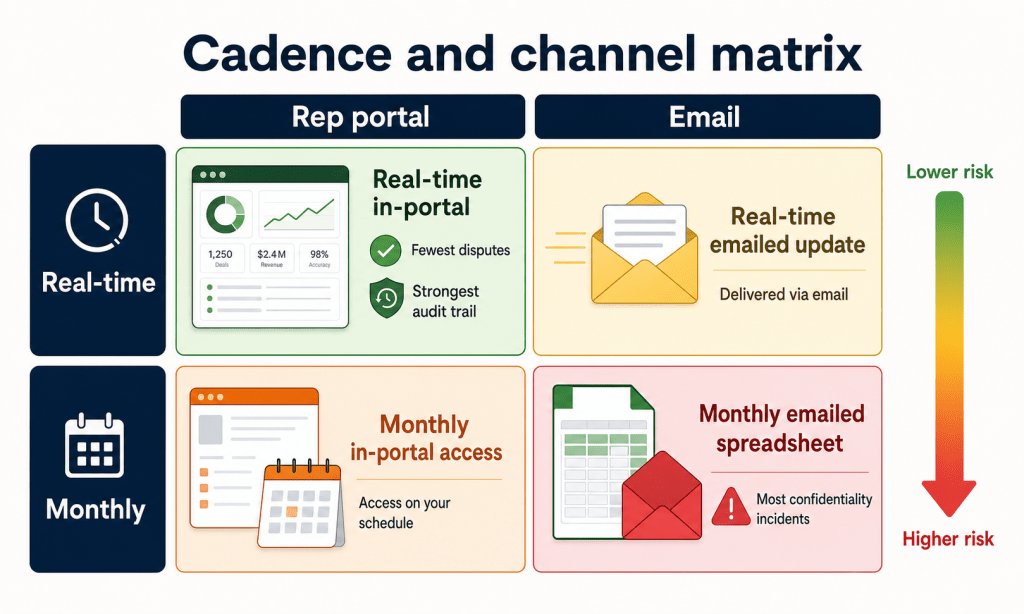
Cadence and channel are separable choices. Cadence is how often the rep sees the statement; channel is where the rep sees it.
On cadence, three options are common: monthly (aligned with payroll), quarterly (aligned with plan attainment period), and real-time (rep dashboard updated continuously as CRM changes flow in). The strongest programs run all three: a real-time dashboard for continuous visibility, a monthly finalized statement for pay, and a quarterly attainment snapshot for review with the manager.
On channel, the historical default (a spreadsheet attached to an email) is now considered a compliance and confidentiality risk. Emailed spreadsheets are forwarded, printed, screenshot, and cross-referenced across reps in ways that surface pay dispersion. A rep portal with individual authentication solves this and generates an access log that is useful in any subsequent dispute or audit.
| Delivery channel | Pros | Cons |
|---|---|---|
| Emailed PDF | Simple; familiar; portable | Forwardable; no access log; hard to correct once sent |
| Emailed spreadsheet | Reps can filter; drill-down possible | Confidentiality risk; version drift; formulas can be tampered with |
| Rep portal (self-service) | Access log; single source of truth; supports drill-down; supports acknowledgment workflow | Requires platform; onboarding cost |
| Payroll stub only | No parallel system | No transaction detail; guaranteed to generate disputes |
The rep portal option becomes even more useful when the statement is paired with an acknowledgment workflow, where the rep clicks to confirm receipt and can either accept or file a dispute within a defined window. This is a materially stronger legal posture than “we assume the emailed spreadsheet was received.”
The six ways statements go wrong
Bad statements share a small set of failure modes. Fixing all six is inexpensive, high-leverage work.
Failure 1: totals without the underlying detail
A one-line statement that says “Q2 commission $27,400” and nothing else forces the rep to shadow-account the number themselves (see our manager override and crediting engine pieces for what “detail” should include).
Failure 2: unlabeled formula outputs
Statements that show a number like “Effective rate 6.85%” without showing which tier produced it, or what the plan tier boundaries are, leave the rep to reverse-engineer the plan from the output.
Failure 3: silent adjustments
A prior-period correction that lands in the current statement as an unlabeled adjustment line is the fastest known way to generate a dispute. Every adjustment needs a type, an amount, a reason code, and an approver.
Failure 4: split partners not named
If a deal is split 60/40, the rep should be able to see who received the other 40 percent (or 60 percent, from their own perspective on the counterpart’s statement). Splits that hide the counterpart erode trust because reps assume the missing information hides an over-allocation.
Failure 5: no appeal process on the statement itself
The statement should tell the rep how long they have to raise an issue, who to raise it with, and what the resolution timeline is. A statement without this section implicitly says “there is no appeal.”
Failure 6: retroactive silent restatement
The rep saved a copy of last month’s statement. Two weeks later, the same period in the portal shows a different number, with no explanation. Every restated period should be flagged in the portal with a note explaining what changed and why. The prior version should remain viewable.
Confidentiality and access control
Individual commission data is sensitive. It is also information that reps compare across each other, formally and informally. Two access-control principles apply. First, each rep sees only their own statement. Second, each manager sees their team’s statements (with clear scope, typically direct reports only). Everything above that goes through defined roles: sales ops, finance, HR business partners, and the CRO. Wide open access “to everyone in sales leadership” is a common mistake that eventually results in a confidentiality complaint or an equal-pay claim.
Access logs matter too. If a dispute or investigation follows, the ability to show that the rep viewed the statement on a specific date and acknowledged it is materially stronger than “we emailed something last quarter.”
The rep view versus the manager view versus the finance view
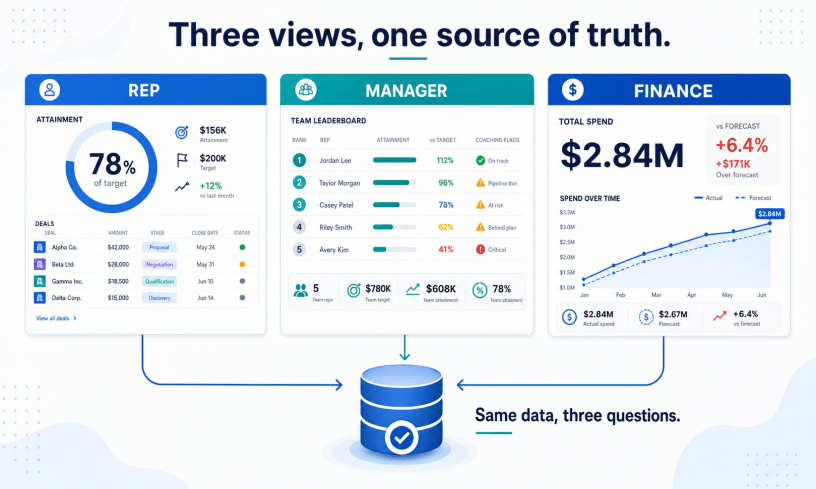
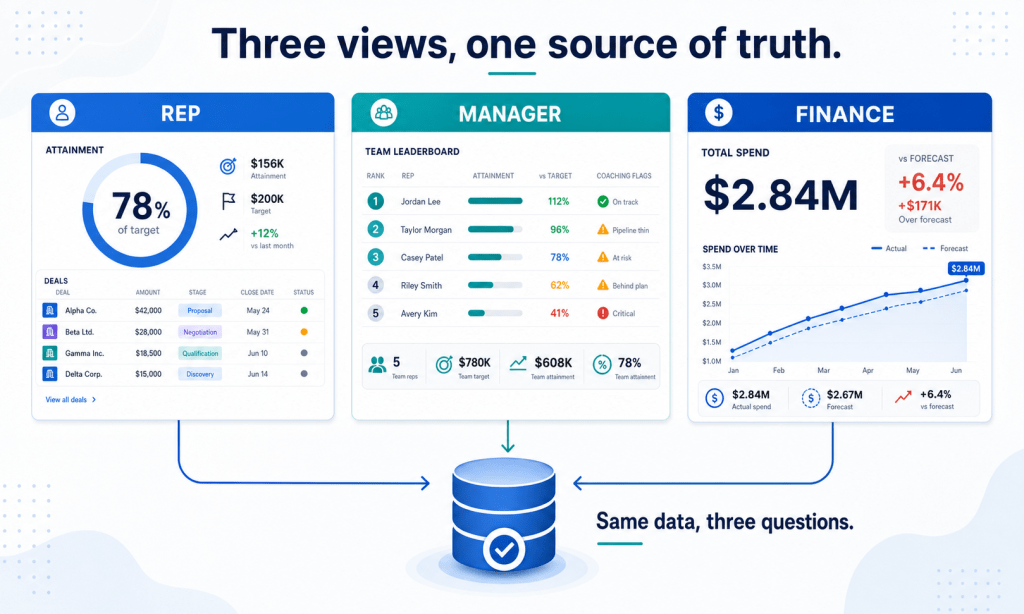
A well-designed statement system exposes three different views of the same underlying data.
| View | Emphasis | Scope |
|---|---|---|
| Rep view | Attainment, transactions, payout, appeal | Own data only |
| Manager view | Team attainment distribution, outliers, coaching flags | Direct reports |
| Finance / Sales Ops view | Total variable cost, variance vs forecast, reconciliation to payroll | All teams; often segmented by business unit |
These views draw from the same data model and the same calculation, but they answer different questions. A statement platform that only exposes the rep view produces a lot of manual work in finance. A platform that only exposes the finance view produces a lot of shadow accounting on the rep side.
Statements and compliance: what a great statement gives you legally
A well-formed commission statement is the most useful piece of evidence in any commission dispute, wage-and-hour claim, or audit. Three specific properties matter.
- Reproducibility. Every number on the statement traces to a specific transaction and a specific rule in a specific plan version. If a labor attorney asks for the calculation basis of a $17,300 payout from Q3 2023, the answer is a report, not a scramble.
- Acknowledgment. The rep viewed the statement, on a specific date, from a specific IP, and either accepted it or filed an appeal. This closes the “I never saw that” argument.
- Immutability. Prior versions of the statement remain viewable when a restatement occurs, with a clear diff and a reason. This prevents the argument that the employer silently rewrote history.
All three of these properties are functions of the platform, not the plan design. A perfect plan on a spreadsheet-and-email delivery model produces none of them. See our pricing guide for what to look for in a platform, and our compliance guide for the state-specific documentation requirements.
The seven-question statement audit
- Can every number on a current statement be traced to a specific transaction and a specific plan-version rule?
- Does every adjustment carry a type, amount, reason code, approver, and effective date?
- Do reps see split-partner names on any deal they share?
- Does the statement include an appeal window and process?
- Is the statement delivered through an authenticated portal with access logs, not as an emailed spreadsheet?
- When a period is restated, is the prior version preserved and the change flagged?
- Do we have separate rep, manager, and finance views drawn from a single source of truth?
A “no” to any of these questions is a fixable design problem, not a fundamental limitation. The fixes cost mostly design and configuration effort, not development, if the underlying platform supports them.
What to do next
Statement design is where trust between the company and the sales team is either built or eroded, one line item at a time. Sales Cookie’s rep portal is built around the anatomy described in this article: authenticated per-rep access, real-time attainment view, transaction-level detail with drill-down to source, labeled adjustments with reason codes, acknowledgment workflow, and preserved prior versions on any restatement. If you want to see the specific pages your reps and managers will use, book a 30-minute demo.
Related reading
- Inside a crediting engine
- Manager override workflow
- Retroactive corrections and true-ups
- Sales commission disputes: anatomy and prevention
- Sales commission glossary
- Pricing of sales commission software
Sources and notes
- Sales Cookie support portal, Plan Configuration Checklist and related articles.
- Sales Cookie research on shadow-accounting rates and adminstration time, referenced on salescookie.com.
- Industry 2024 sales trends research cited on the Sales Cookie University page: 78 percent of leaders say reps cannot fully understand their plans.
- US Department of Labor, Fair Labor Standards Act and applicable state wage-payment guidance for statement-related recordkeeping.
- Statement design principles and field lists are drawn from the Sales Cookie implementation playbook and the practical checklist in the Sales Cookie support portal, current as of June 2026.

