Reading time: about 12 minutes. A grounded look at where AI is actually delivering value in Sales Operations in 2026, where it is still hype, and the five use cases that pay back fastest.
Two years into the generative AI boom, Sales Operations leaders have stopped asking whether AI matters and started asking which AI projects to fund. McKinsey’s State of AI 2024 reported that 65 percent of organizations now use generative AI in at least one function, up from 33 percent the prior year, with sales and marketing among the top three areas of adoption. The Salesforce State of Sales 2024 survey found 81 percent of sales teams are investing in AI capabilities. The question for Sales Ops is no longer “should we?” but “where, in what order, and how do we measure it?”
This guide separates the use cases that are paying back today from the ones still on the hype cycle, and gives a measurement framework for each.
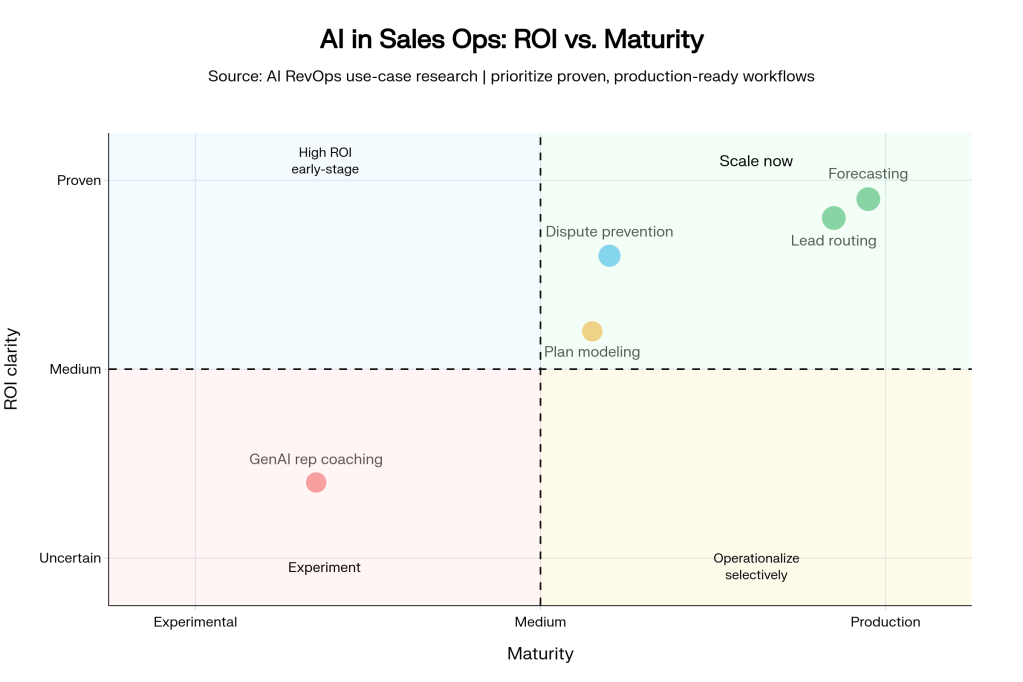
The five use cases paying back today
1. AI-assisted forecasting
What it does: Combines deal-level activity signals (email volume, meeting count, late-stage stakeholders) with historical close patterns to produce a probability score for each deal closing in-period. Replaces or complements rep-call sales judgment.
Where it pays off: Forecast accuracy improvements of 10 to 20 percentage points are typical in the first year, especially in mid-market and enterprise deal motions where signals are richer. Salesforce reports that AI-assisted forecasting users see ~28 percent better forecast accuracy than non-users.
What it does not replace: The forecast call itself. AI scoring informs the rep and manager, but the commit number remains a human decision tied to compensation and accountability.
2. Lead and account routing
What it does: Models historical conversion data to assign leads to the rep most likely to close them, considering segment fit, geographic ownership, capacity, and rep specialty. Replaces rules-only routing that breaks every time territory carving changes.
Where it pays off: Speed-to-lead improvements of 30 to 60 percent and conversion lifts of 8 to 15 percent in companies with non-trivial volume. The improvement is largest in inbound-heavy SMB motions.
What to watch: Bias in historical data. If a model trained on past conversions sends all enterprise leads to one rep, you have automated a fairness problem. Audit routing decisions against rep capacity quarterly.
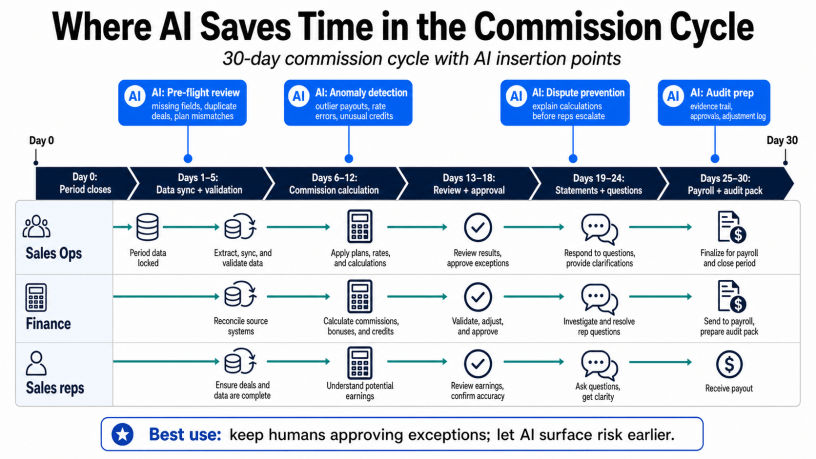
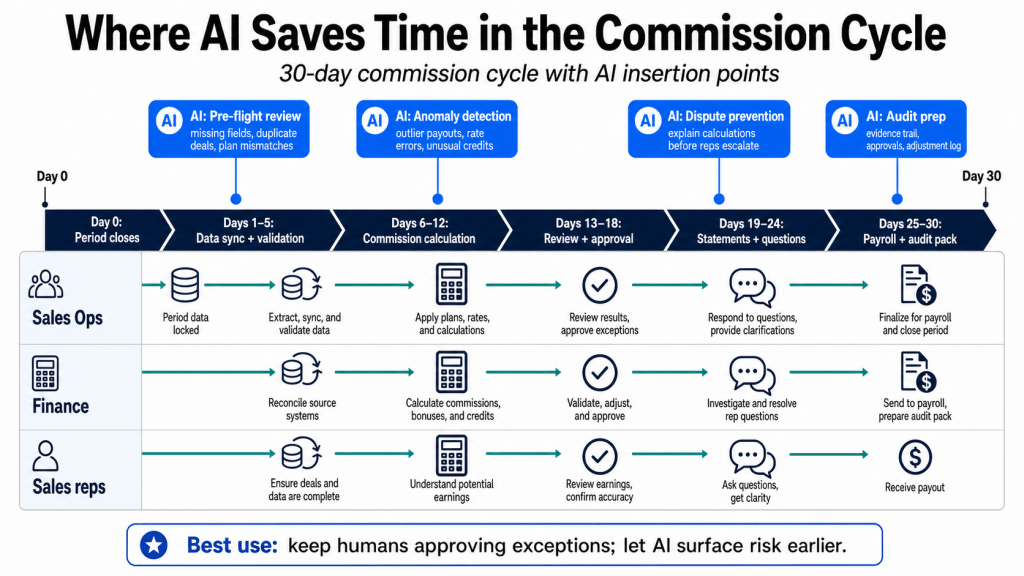
3. Commission dispute pre-detection
What it does: Scans calculated commission statements for anomalies before they go to reps. Flags deals where ownership is ambiguous, splits look unusual, or attainment jumped abruptly. Routes flagged statements to Sales Ops review before the rep sees them.
Where it pays off: 40 to 60 percent reduction in formal disputes is common. Even a modest reduction has outsized impact because each dispute consumes finance, ops, and manager time and corrodes rep trust. Sales Cookie’s AI dispute prevention sits in this category.
What to watch: False-positive rates. The cost of a flagged-but-correct statement is rep frustration. Tune the model conservatively at first.
4. Comp plan modeling and what-if analysis
What it does: Runs a proposed plan against historical bookings to predict total comp expense, attainment distribution, and rep-by-rep changes. Stress-tests against multiple scenarios in seconds rather than days.
Where it pays off: Faster plan-design cycles, fewer surprises after launch, and the ability to negotiate plan trade-offs with sales leadership using real numbers rather than gut feel.
What to watch: Historical data is not the future. A new product, a new pricing model, or a shift in segmentation will outdate the back-test. Always pair model output with judgment.
5. Pipeline hygiene and CRM cleanup
What it does: Identifies stale opportunities, missing close dates, mismatched account ownership, and duplicate accounts. Suggests bulk actions or routes them to the right rep for cleanup.
Where it pays off: Forecast accuracy and reporting reliability. Most Sales Ops teams underestimate how much of their forecasting error is rooted in dirty CRM data, not in poor methodology.
What to watch: Auto-actions that close opportunities reps still believe are alive. Always require human confirmation on terminal state changes.
The matrix: what works, what is hype
| Use case | Maturity | Typical payback | Sales Ops effort to deploy |
|---|---|---|---|
| AI-assisted forecasting | Production | 2 to 3 quarters | Medium |
| Lead and account routing | Production | 1 to 2 quarters | Low to Medium |
| Commission dispute pre-detection | Production | 1 quarter | Low (with right tooling) |
| Comp plan modeling | Production | Annual cycle | Medium |
| Pipeline hygiene | Production | 1 to 2 quarters | Low |
| GenAI deal coaching | Emerging | Unproven | High |
| Auto-generated proposals | Emerging | Mixed results | High |
| Fully autonomous AI SDR agents | Hype | Negative in most cases | High and risky |
Where to NOT use AI in Sales Ops
The fastest way to lose Sales Ops credibility is to deploy AI in places where it produces confidently wrong outputs that affect rep pay or trust. Specifically:
- Final commission calculation. The math should be deterministic. AI can flag, suggest, or detect, but the final number paid to a rep needs to be auditable to a rule, not to a model.
- Plan compliance interpretation. “Did this deal qualify for the accelerator?” is a contract-language question, not a model question. Use AI to surface ambiguous cases, not to resolve them.
- Quota assignment. Reps deserve a quota that comes from a defensible methodology (territory potential, top-down split, or rep capacity), not a black-box model.
- Dispute resolution. The AI can prevent and route, but the rep’s appeal needs a human owner.
How to measure AI investments in Sales Ops
| Use case | Primary KPI | Secondary KPI |
|---|---|---|
| Forecasting | Forecast accuracy (% of commit hit) | Variance reduction at month 1 vs. month 3 forecast |
| Routing | Lead-to-meeting conversion rate | Speed-to-first-touch |
| Dispute prevention | Disputes per 100 statements | Average dispute resolution time |
| Comp modeling | Plan-launch surprise % (variance from projected total comp) | Time to model a plan change |
| Pipeline hygiene | % of opps with stale data > 30 days | CRM data quality score (composite) |
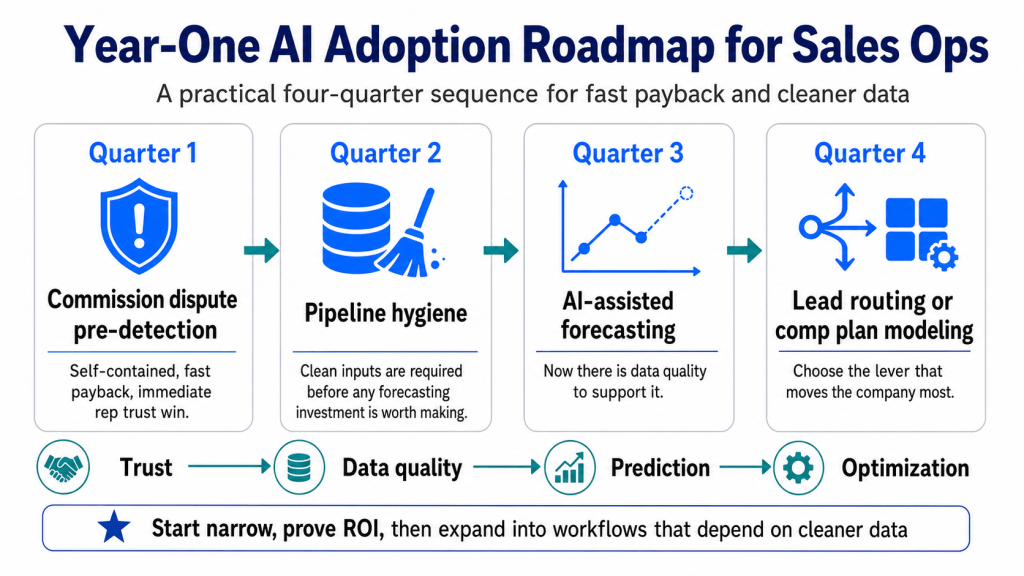
Implementation order
If a Sales Ops team is starting fresh, the natural sequencing prioritizes the use cases that touch fewer systems and have the cleanest measurement.
- Quarter 1. Commission dispute pre-detection. Self-contained, fast payback, immediate rep trust win.
- Quarter 2. Pipeline hygiene. Clean inputs are required before any forecasting investment is worth making.
- Quarter 3. AI-assisted forecasting. Now there is data quality to support it.
- Quarter 4. Lead routing or comp plan modeling, depending on which lever moves the company most.
Bottom line
AI in Sales Operations is real, but the value is concentrated in a small number of well-understood use cases. The teams winning are pragmatic: pick a use case with a clear measurement, deploy it on a quarter timeline, prove the ROI, and only then move to the next. The teams stuck are the ones running pilots without commitment, chasing every demo, and ending the year with a slide deck instead of a number.
Commission dispute pre-detection is one of the highest-ROI starting points because the savings are visible the same month. Sales Cookie uses AI specifically to flag anomalies before statements reach reps, cutting disputes before they happen. Read our companion piece on how AI closes the trust gap on commissions.
Sources: McKinsey, State of AI 2024; Salesforce State of Sales 2024; HubSpot State of Sales; Gartner Sales research.
 Sales Commissions Explained