Reading time: about 14 minutes. Salary, skills, and career path data for Sales Ops professionals in 2026, with hiring benchmarks for managers building out the function.
Sales Operations went from “the analyst nobody could quite place on the org chart” to a strategic function that owns territory design, comp plans, forecast accuracy, GTM tooling, and increasingly, AI-driven revenue insights. The pay reflects the shift. So does the difficulty of hiring. This guide walks through what Sales Ops earns in 2026, what skills hiring managers should screen for, and how to build a career ladder that actually retains the talent.
What Sales Ops actually owns in 2026
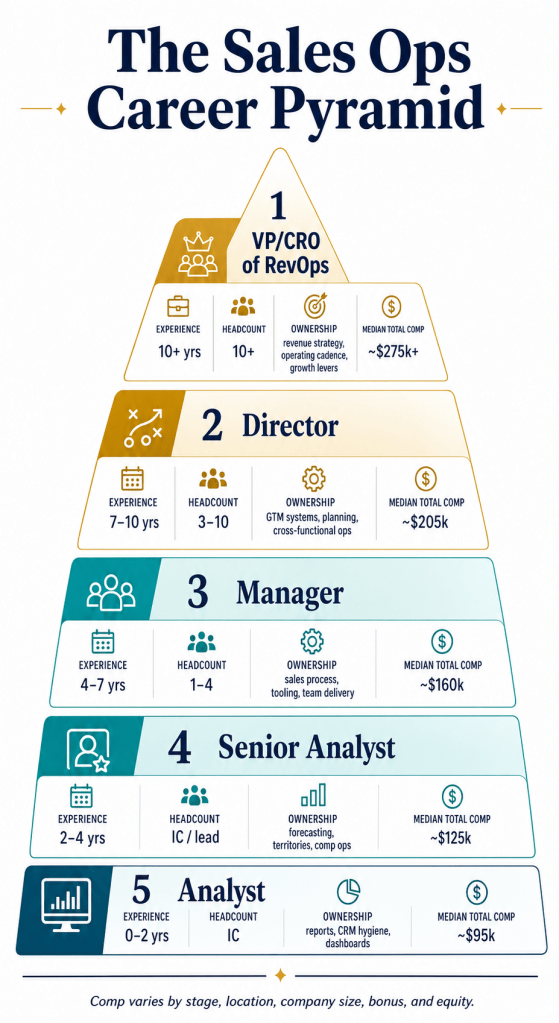
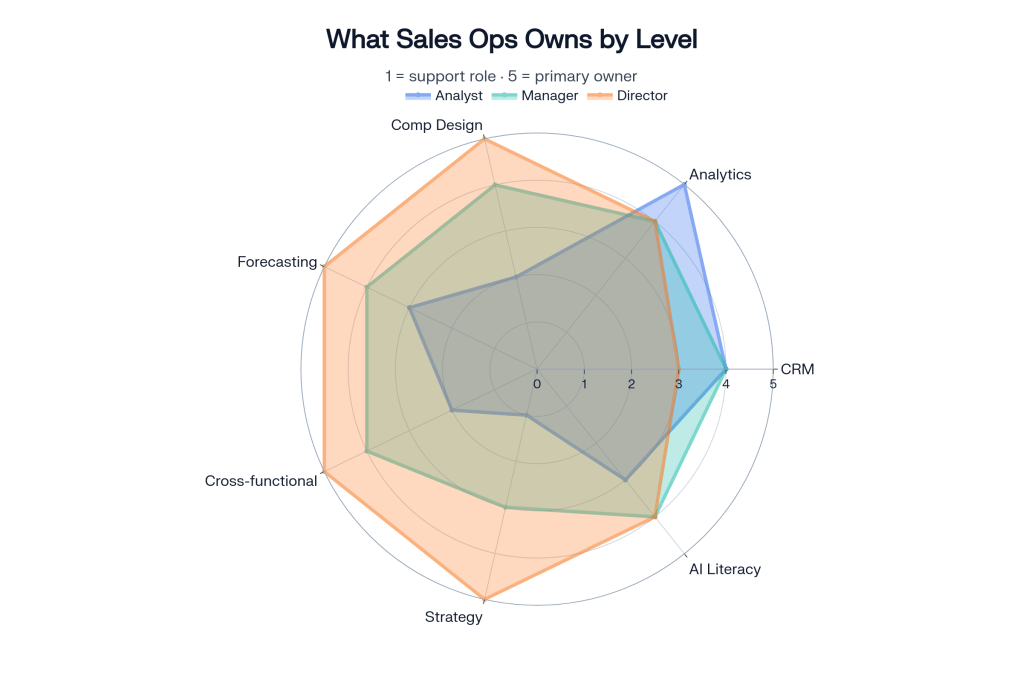
The function has expanded. A modern Sales Ops team is responsible for some or all of the following, in roughly increasing order of seniority:
- CRM administration, hygiene, and pipeline reporting
- Forecast cadence and methodology
- Quota design and territory carving
- Compensation plan design, modeling, and administration
- GTM tech stack ownership (CRM, sales engagement, conversation intelligence, commission)
- Sales analytics and KPI dashboards
- Lead routing and SLA enforcement
- AI-assisted forecasting, deal scoring, and dispute prevention
- Cross-functional partnership with Finance, Marketing, and CS (this is where RevOps shows up)
The blurred line between Sales Ops and RevOps matters for compensation and career path. RevOps generally implies cross-functional ownership across Sales, Marketing, and CS. Sales Ops can sit inside that broader RevOps function or operate as a standalone team reporting into the CRO.
2026 compensation benchmarks
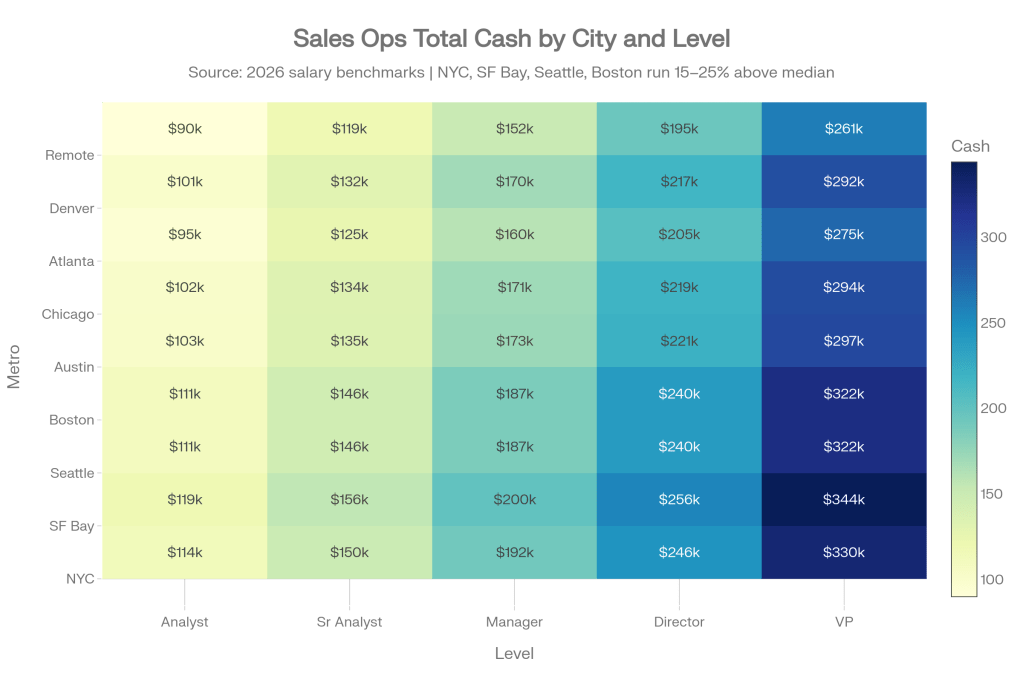
The U.S. Bureau of Labor Statistics tracks Operations Research Analysts as the closest official occupation. The May 2024 median wage was $91,290, with the 90th percentile at $148,920. That is a useful floor reference, but Sales Ops in tech consistently runs above the BLS median because the role includes equity, variable comp, and a tech industry premium. The numbers below blend BLS data with public salary aggregators and industry reporting.
| Level | Years | Base salary range | Total cash comp | Equity (typical) |
|---|---|---|---|---|
| Sales Ops Analyst | 0 to 2 | $70K to $95K | $80K to $110K | Modest in public co; meaningful in startup |
| Senior Sales Ops Analyst | 3 to 5 | $95K to $130K | $110K to $150K | Refresh grants common |
| Sales Ops Manager | 5 to 8 | $130K to $170K | $150K to $210K | Material at growth-stage |
| Director, Sales Ops / RevOps | 8 to 12 | $170K to $230K | $220K to $310K | Larger grants, often tied to company-wide GTM metrics |
| VP RevOps / Chief Operating Officer | 12+ | $230K to $330K+ | $310K to $500K+ | Significant equity component |
Geography still drives a meaningful premium. New York, San Francisco Bay Area, Seattle, and Boston typically sit 15 to 25 percent above the U.S. median. Remote-first companies have narrowed the gap somewhat but rarely closed it.
The skill matrix
Sales Ops candidates split into two profiles, and the best ones bridge both. The technical-analytical profile lives in SQL, dashboards, and CRM data models. The cross-functional-strategic profile lives in deal desks, plan design, and exec readouts. Hiring managers regret hiring purely on one axis or the other.
| Category | Skill | Required by level |
|---|---|---|
| Technical | CRM admin (Salesforce, HubSpot) | Analyst+ |
| Technical | SQL and data modeling | Senior Analyst+ |
| Technical | BI tools (Looker, Tableau, PowerBI) | Analyst+ |
| Technical | Commission tooling fluency | Manager+ |
| Analytical | Forecasting methodology | Senior Analyst+ |
| Analytical | Quota and territory design | Manager+ |
| Strategic | Comp plan design and modeling | Manager+ |
| Strategic | GTM motion design | Director+ |
| Cross-functional | Working with Finance on accruals and ASC 606 | Manager+ |
| Cross-functional | Executive communication | Director+ |
| Emerging | AI / ML literacy for forecasting and routing | Senior Analyst+ |
Certifications and training that matter
| Certification | Time investment | Best for level | Why hiring managers value it |
|---|---|---|---|
| Salesforce Administrator (ADM-201) | 2 to 3 months self-study | Analyst | Validates baseline CRM fluency |
| Salesforce Advanced Admin / Platform App Builder | 3 to 4 months | Senior Analyst | Signals deeper Salesforce ownership |
| HubSpot CRM / Sales Hub | 2 to 4 weeks | Analyst | SMB-heavy companies expect this |
| Pavilion RevOps School | 8 weeks cohort | Manager+ | Strategic frameworks and peer network |
| RevOps Co-op community courses | Variable | All levels | Practical, current content |
| SaaS Academy / Winning by Design | Multi-week | Director+ | GTM motion and strategy |
Career ladder template
The healthiest Sales Ops orgs publish a written ladder. Reps and analysts can see what the next level requires before their manager has to explain it. A defensible template:
- Analyst. Owns reports, dashboards, CRM hygiene, and ticket queue. Promoted by demonstrating reliability, accuracy, and breadth across reporting needs.
- Senior Analyst. Owns specific motion or segment (e.g., enterprise pipeline, SDR routing). Builds analytical models. Promoted by independent ownership of a measurable improvement.
- Manager. Owns a team (1 to 3 analysts) and a domain (e.g., comp, forecasting, tech stack). Promoted by leading a successful FY plan rollout or platform implementation.
- Director. Owns Sales Ops or sub-RevOps function. Cross-functional partner with CRO, CFO, and CMO. Promoted by demonstrably moving company-wide metrics.
- VP RevOps / COO. Owns end-to-end revenue operations across Sales, CS, Marketing. Reports to CEO or CRO. Promoted into.
What hiring managers should screen for
The interview gauntlet for a strong Sales Ops hire should test five things, in increasing order of difficulty.
- Data work. A SQL or spreadsheet exercise on real-looking pipeline data. The candidate should be able to explain their assumptions, not just produce a number.
- Plan design. “Design a plan for a 12-rep mid-market AE team in our segment.” Listen for whether they ask about quotas, attainment distribution, and clawbacks.
- Stakeholder management. “A rep escalates a dispute claiming the system shorted them. Walk us through your response in the next 24 hours.” Listen for empathy and process discipline.
- Forecast accuracy. “Walk us through how you would diagnose persistent forecast inaccuracy at this company.” Listen for first-principles thinking, not tool name-dropping.
- Strategic taste. “If you owned RevOps here, what is the first thing you would change in your first 90 days?” Listen for prioritization and humility.
Retention: why Sales Ops talent leaves
Sales Ops practitioners typically leave for one of four reasons. Recognizing them early prevents the painful re-hire.
- No path up. The function is two people deep with the senior person not going anywhere. Ambitious analysts leave for a Manager title elsewhere.
- The data is broken and they get blamed. If pipeline data is unreliable and Sales Ops is held accountable for forecast accuracy, the role becomes punitive.
- Leadership treats Sales Ops as ticket queue. When the team only does what reps and managers ask, instead of partnering on strategy, the smartest people leave.
- Tools are 5 years out of date. Strong Sales Ops people will not stay in an environment where commissions are calculated by hand and the forecast lives in a slide deck.
Bottom line
Sales Ops is one of the most leveraged roles in a modern revenue org. The talent is more available than three years ago, the comp is rising, and the function expects modern tooling. Companies that pay competitively, publish a written ladder, and keep the GTM stack current will retain the talent. Companies that do not will fund the careers of their competitors.
If your Sales Ops team is still calculating commissions in Excel, you are not retaining the senior analysts. See how Sales Cookie handles plan design, calculation, and rep statements end-to-end, or read our companion commission structures guide.
Sources: BLS Operations Research Analysts (May 2024); BLS OES 15-2031 detailed wages; Salesforce State of Sales 2024; Pavilion RevOps School; Bridge Group SaaS Sales Compensation benchmarks; public Levels.fyi and Salary.com aggregator data.
 Sales Commissions Explained