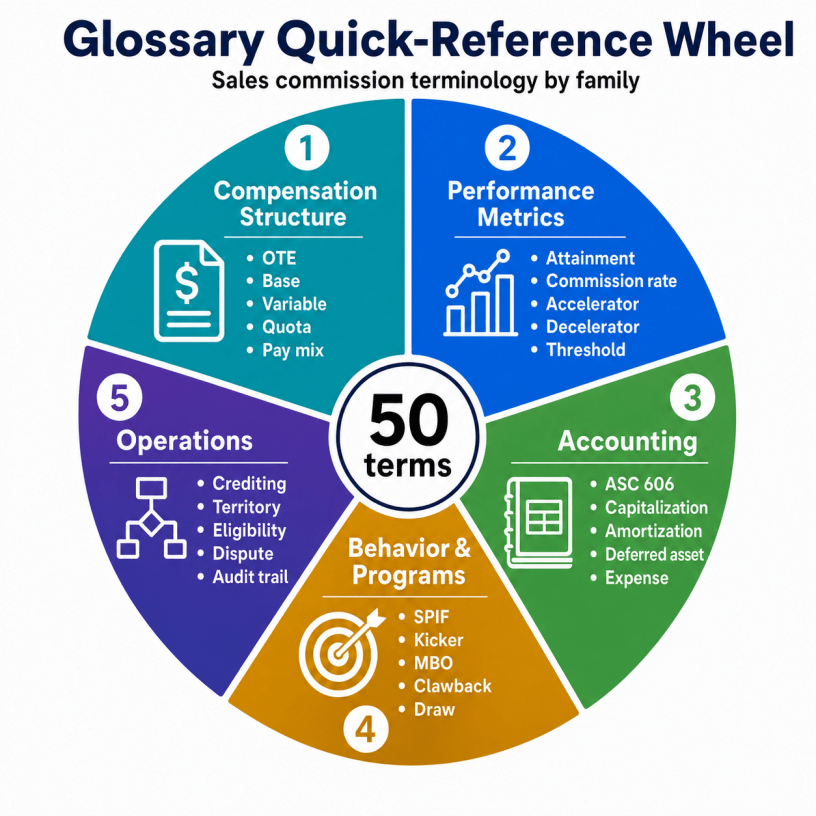
Reading time: about 14 minutes. Fifty essential sales commission and compensation terms, defined in plain language with one or two example sentences each. Built for new Sales Ops hires, finance staff, and sales leaders who want a single reference.
Sales compensation has its own dialect. The terminology is drawn from accounting, behavioral economics, contract law, and decades of inherited industry practice, and it does not always reconcile internally. A clean glossary saves time. The fifty terms below cover the essentials, grouped by family. Where a term shows up across families, the cross-reference is noted.
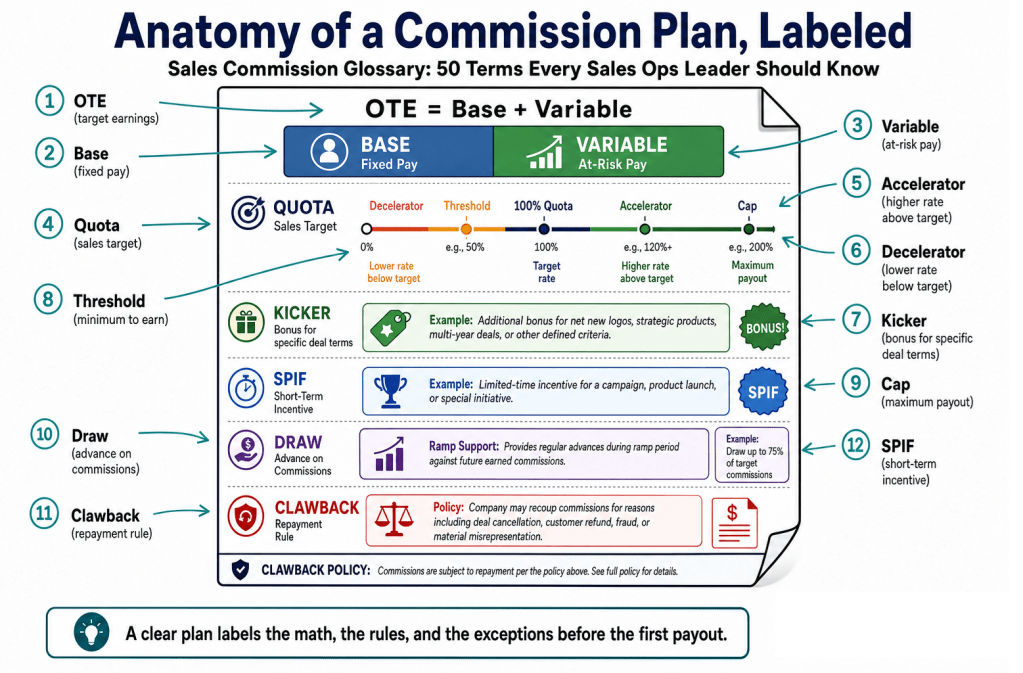
Quick-reference family map
| Family | Sample terms |
|---|---|
| Compensation structure | OTE, base, variable, pay mix, accelerator, decelerator, kicker, threshold, cap, tier, ramp |
| Performance metrics | ACV, ARR, TCV, bookings, attainment, quota, win rate, pipeline coverage, average deal size |
| Accounting and finance | ASC 606, capitalization, amortization, period of benefit, accruals, P&L recognition, deferred commission asset |
| Behavior and program design | SPIF, MBO, stretch goal, kicker, residual commission, draw, recoverable / non-recoverable |
| Operations and contracts | Plan document, effective date, retroactive adjustment, split, territory, clawback, dispute, plan acknowledgement |
The 50 terms
1. Accelerator
An increased commission rate that activates when the rep crosses a defined attainment threshold (e.g., 1.5x rate above 100 percent quota). Rewards overachievement. Example: “She hit the accelerator at 105 percent and earned 1.5x on the next deal.”
2. Acknowledgement
The signed acceptance by a rep of the current plan document. Required by California Labor Code 2751 and similar statutes. Example: “All reps must complete plan acknowledgement before their first deal of the year is counted.”
3. ACV (Annual Contract Value)
The dollar value of a contract normalized to a one-year period. Excludes one-time fees. Example: “The deal is $90K TCV but the ACV is $30K because it is a 3-year contract.”
4. Amortization
The systematic recognition of a capitalized commission expense over the expected period of benefit. Required by ASC 340-40 for commissions outside the practical expedient. Example: “We amortize this commission over 36 months because the customer relationship benefit extends past the initial term.”
5. ARR (Annual Recurring Revenue)
The annualized run rate of recurring revenue from an active subscription. Excludes one-time fees and non-recurring services. Example: “We compensate AEs on net new ARR rather than on TCV.”
6. ASC 606
The U.S. revenue recognition accounting standard. Sub-topic 340-40 specifies the treatment of commissions as contract acquisition costs. Example: “Under ASC 606, we capitalize this commission and amortize over the expected period of benefit.”
7. Attainment
A rep’s actual performance expressed as a percentage of quota. Example: “Q2 attainment was 87 percent across the team.”
8. Average deal size
Total bookings divided by number of closed deals in a period. Used in territory design and quota setting. Example: “Average deal size dropped 12 percent quarter over quarter; let’s investigate discounting.”
9. Base salary
The fixed component of a rep’s compensation, paid regardless of performance. Example: “AE base is $80K, OTE is $160K, with a 50/50 pay mix.”
10. Bookings
The contracted value of deals signed in a period. Distinct from billings (invoiced) and revenue (recognized). Most B2B reps are paid on bookings. Example: “We grant accelerator credit on Q4 bookings, not billings.”
11. Cap
The maximum commission a rep can earn in a period or on a single deal. Capped plans are uncommon in software sales because they suppress overperformance. Example: “We removed the cap last year and saw a 7 percent lift in bookings.”
12. Capitalization
Recording a commission as a balance-sheet asset (deferred commission asset) rather than an immediate P&L expense. Required when the commission is incremental to obtaining the contract and the period of benefit exceeds one year. See our ASC 606 capitalization guide.
13. Clawback
Recovery of previously paid commission when a triggering event (refund, churn, non-payment) occurs. See our complete clawback guide. Example: “The clawback policy applies if the customer cancels within 180 days of contract start.”
14. Commission cap
See “Cap.” Sometimes specifically the maximum commission on a single deal.
15. Decelerator
A reduced commission rate below a defined attainment threshold (e.g., 0.5x rate below 50 percent quota). Used to prevent over-paying poor attainment. Example: “Decelerator below 50 percent keeps the comp expense controlled when ramp reps are not yet productive.”
16. Deferred commission asset
The capitalized portion of commissions yet to be amortized to P&L. Sits on the balance sheet under contract acquisition costs. Example: “Our deferred commission asset is $4.2M at quarter-end, amortizing $350K per month.”
17. Dispute
A formal request from a rep to review a commission calculation. Should follow a documented workflow. See our disputes anatomy. Example: “Q1 disputes per 100 statements dropped from 12 to 4 after pre-detection went live.”
18. Draw
An advance against future commission, typically used during ramp or seasonal slow periods. Two flavors: recoverable (must be earned back) and non-recoverable (forgiven). Example: “Ramp reps get a 6-month non-recoverable draw of $2K per month.”
19. Effective date
The date a plan, plan amendment, or comp change takes effect. Used to determine which deals are covered by which plan version. Example: “The plan change has an effective date of April 1; deals booked in March still use the prior plan.”
20. Forecast category
The label applied to an opportunity indicating its forecast probability (Pipeline, Best Case, Commit, Closed). Used by Sales Ops for forecast roll-up. Example: “Move the deal from Best Case to Commit only after the pricing review is complete.”
21. Gross margin commission
A commission calculated on gross margin (revenue minus COGS) rather than revenue. Used to align rep behavior with deal profitability. Example: “Switching from revenue-based to gross-margin-based comp reduced unprofitable discounting by 20 percent.”
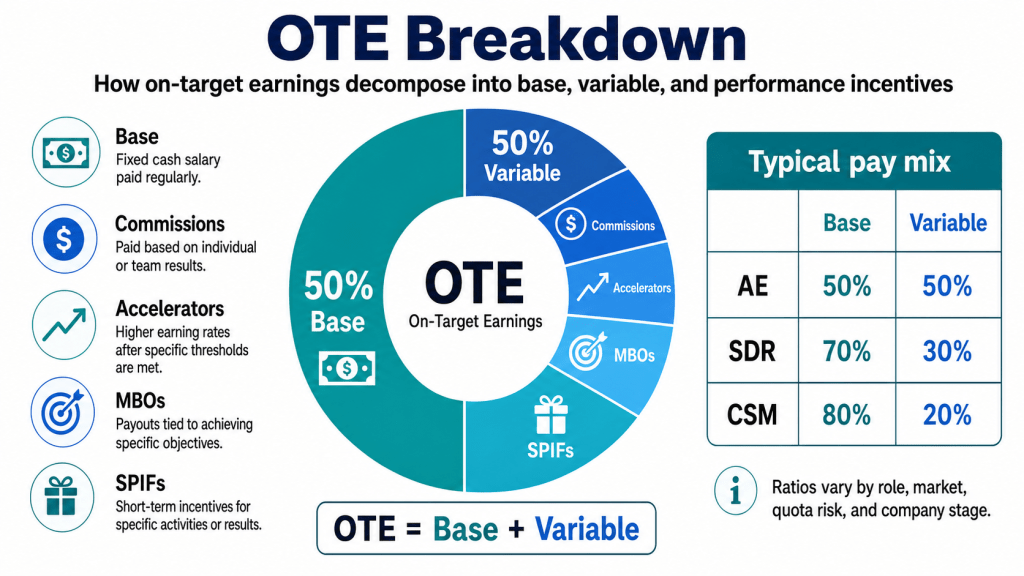
22. Kicker
A bonus payout layered on top of base commission for hitting a specific milestone (first deal of quarter, multi-product attach). Often time-bounded; similar to but distinct from a SPIF. Example: “We added a kicker for any AE who closes a deal in their first 60 days.”
23. MBO (Management By Objectives)
A bonus tied to specific qualitative objectives rather than purely quantitative results. Common in CSM, sales engineering, and management roles. Example: “The CSM’s quarterly MBO is tied to onboarding-NPS above 60.”
24. Net new ARR
New ARR added in the period excluding expansion of existing customers and net of churn. The cleanest measure of new-customer growth. Example: “Q2 net new ARR was $1.1M, against $1.3M of expansion.”
25. Non-recoverable draw
An advance that the rep keeps regardless of future earnings. Typical during ramp. Example: “The non-recoverable draw drops to $0 after month 6.”
26. On-target earnings (OTE)
The total annual cash compensation a rep would earn at 100 percent attainment. Sum of base salary plus on-target variable. Example: “AE OTE in this segment is $180K, with a 60/40 base/variable mix.”
27. Pay curve
The functional relationship between rep attainment and commission earned. Linear, tiered, S-curve, or step. Example: “We moved from a step pay curve to a tiered curve to reduce edge-case disputes.”
28. Pay mix
The split of OTE between base salary and variable compensation. Often expressed as a ratio (60/40, 50/50). More variable typically signals more sales-driven roles. Example: “The pay mix is 50/50 for closing AEs and 70/30 for inside reps.”
29. Pipeline coverage
The ratio of pipeline to remaining quota for a period. Industry rule of thumb is 3 to 4x at quarter start. Example: “Q3 starts with 3.2x coverage; we should hit if conversion holds.”
30. Plan document
The written, signed agreement between rep and company defining how commission is earned and paid. Required by state law in CA, NY, IL, and others. Example: “The plan document has all the math and the clawback rules; it should be the rep’s first reference.”
31. Practical expedient
An ASC 606 / 340-40 simplification that allows expensing commissions immediately rather than capitalizing them, when the amortization period would be one year or less. Example: “Most month-to-month and annual SaaS contracts qualify for the practical expedient.”
32. Quota
The performance target a rep is expected to achieve in a period. Often expressed in bookings, ARR, or deals closed. Example: “The new AE quota is $1.2M ARR for the year.”
33. Quota relief
A reduction in a rep’s quota for a defined reason (parental leave, territory change, role change). Example: “She received quota relief equal to one month’s allocation during her PTO.”
34. Ramp
The defined period during which a new rep’s quota is reduced and may include a non-recoverable draw. Typical ramp is 3 to 6 months. Example: “Ramp quota in month 1 is 25 percent of full quota, climbing to 100 percent by month 6.”
35. Recoverable draw
An advance that must be earned back through future commissions. Functions like a non-interest-bearing loan. Example: “Recoverable draws were phased out in our 2026 plan because of legal exposure on rep terminations.”
36. Residual commission
An ongoing commission earned each period the customer remains. Common for sales of recurring services. Example: “Channel reps earn a 5 percent residual on the customer’s monthly billing for 24 months.”
37. Retroactive adjustment
A change to a previously paid commission. Should be governed by clear policy and avoid surprise. Example: “The clawback was processed as a retroactive adjustment on the next statement, not as a deduction from base salary.”
38. Split
Commission credit divided between two or more reps on the same deal. Common when reps team up across territory or specialty. Example: “The split was 60/40 between the AE and the overlay specialist.”
39. SPIF (Sales Performance Incentive Fund)
A short-duration cash incentive layered on top of regular commission. See our SPIFs playbook. Example: “The Q1 SPIF paid $250 per Service Agreement closed; we paid out $14K and saw 30 percent more attaches.”
40. Stretch goal
A quota set above the expected achievable level, often paired with an accelerator at the stretch threshold. Example: “Stretch goal is 120 percent of quota; reps who hit it qualify for President’s Club.”
41. TCV (Total Contract Value)
The full dollar value of a multi-year contract, including all years and one-time fees. Distinct from ACV. Example: “TCV on this deal is $300K but ACV is $80K, with a one-time setup of $60K.”
42. Territory
The set of accounts assigned to a specific rep. Defined by geography, segment, vertical, or named accounts. Example: “Her territory is healthcare named accounts in the East region.”
43. Threshold
The minimum attainment level required before commission is earned. Most plans have a 50 percent or 60 percent threshold. Example: “Reps below the 50 percent threshold earn no commission for the period; the threshold prevents paying for trivial sales.”
44. Tier
A defined attainment band where the commission rate changes (e.g., Tier 1: 0 to 50 percent at 5 percent rate; Tier 2: 50 to 100 percent at 8 percent rate). Example: “We use a 4-tier pay curve so reps see clear next-level milestones.”
45. True-up
A reconciliation that adjusts commissions in the next period to account for prior-period under- or overpayment. Example: “Q2 statements include a true-up for one Q1 deal that was reclassified as enterprise.”
46. Variable compensation
The performance-based portion of a rep’s pay, including commissions, bonuses, MBOs, accelerators, and SPIFs. Example: “Variable comp made up 50 percent of OTE in 2026, up from 45 percent.”
47. Win rate
The percentage of qualified opportunities that close as won. Used in pipeline coverage and forecast modeling. Example: “Mid-market win rate is 27 percent; enterprise is 19 percent.”
48. Y-T-D (Year-to-Date)
Cumulative attainment, bookings, or commission from the start of the fiscal year. Used in cumulative-quota plans. Example: “Y-T-D attainment is 71 percent through Q3; the rep needs $400K in Q4 to hit annual quota.”
49. Z-payout (Zero payout)
The condition where a rep earns no commission for a period because attainment was below threshold. Note: most plans pay base salary regardless. Example: “Two new reps had a Z-payout in their first month; they were still in ramp.”
50. Zone (Compensation Zone)
A geographic comp tier used when the same role pays differently across cities (e.g., NYC zone vs. Atlanta zone). Required when remote-first companies still want to anchor pay to local labor markets. Example: “Zone 1 (NYC, SF, Seattle) sits at OTE 1.15x base benchmark.”
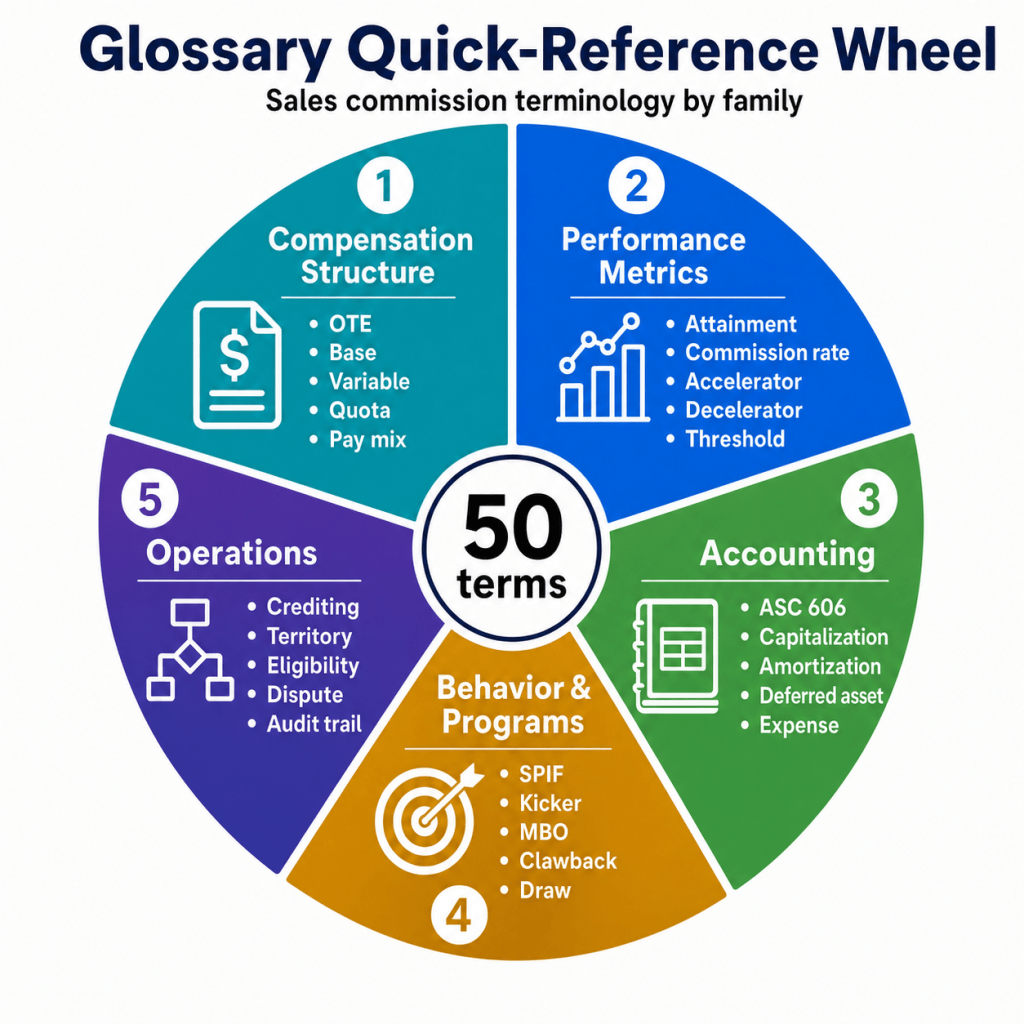
How to use this glossary
The fastest way to onboard a new Sales Ops hire or finance staff member is to share two artifacts: this glossary and the company’s current plan document. The glossary translates the language; the plan document shows the company-specific application. After a week of working through the actual statements, the terminology becomes second nature and the new team member can run a calculation review with confidence.
For sales leaders unfamiliar with the language, focus on five terms first: OTE, attainment, accelerator, threshold, and clawback. These five appear in nearly every comp conversation and unlock the rest of the vocabulary.
Bottom line
Sales compensation language is a small but specific vocabulary. Mastery of fifty terms is enough to read any plan document, follow any comp committee discussion, and audit any statement. Print this page. Bookmark it. Hand it to the next new hire. Most disputes about commission outcomes are actually disputes about terminology.
Looking for a system that supports every term in this glossary? Sales Cookie implements all of the above out of the box, from accelerators and clawbacks to ASC 606 amortization. Pair this glossary with our commission structures guide and our ASC 606 capitalization piece.
Sources: WorldatWork sales compensation research; FASB ASC 340-40; California Labor Code 2751; Bridge Group SaaS AE Metrics & Compensation Research.
 Sales Commissions Explained