Reading time: about 14 minutes. The two patterns for compensating sales managers on their team’s results, when to use each, and the configuration choices that change rep behavior in different directions.
Sales managers are paid for their team’s results. Everyone agrees on that part. What teams disagree about is how. There are two distinct patterns in the wild, and they produce very different manager behaviors. In one pattern the manager is credited with the team’s collective sales and paid against a single attainment number rolled up from the team. In the other, the manager is paid an override on each rep’s individual attainment, summed across the team. The math sometimes lands in similar places. The incentive signal does not.
Picking the right one is one of the highest-leverage decisions in any sales compensation plan above 25 reps. Pick wrong and you will see it in manager coaching behavior, in territory complaints, and in the way managers protect their top performers and tolerate their bottom ones. This article walks through both patterns, the math that distinguishes them, the operational implications, and the configuration in Sales Cookie that supports each.
Pattern A: Collective attainment (team rollup)
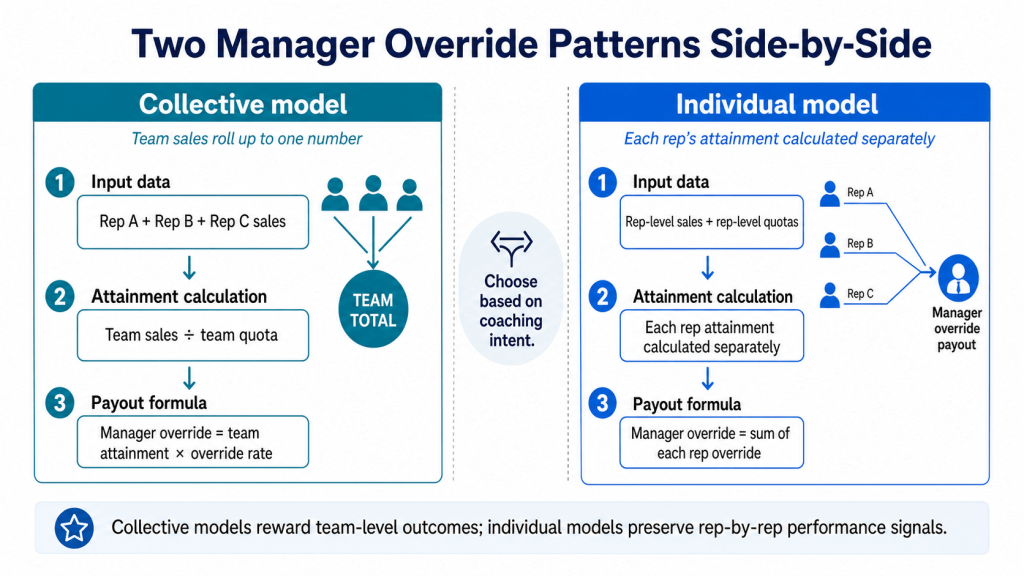
In the collective pattern, all sales generated by the team are aggregated into a single team-level number. The manager has a team-level quota. The manager’s attainment is the team’s collective sales divided by the team’s collective quota, treated as one figure. The manager’s payout is calculated against that single attainment number with whatever tier and accelerator structure the plan defines.
Mechanically, this is implemented in Sales Cookie as a team-based plan: crediting defaults to the “Team or Territory” fields on each transaction, all team members’ sales credit the team, and the team attainment then drives the manager’s payout. Per the Sales Cookie crediting engine documentation, after crediting completes, “rewards may be assigned to credited users / team members” or, as a different strategy, “to user managers or team managers.” That second strategy is exactly the collective override.
Pattern B: Sum of individual attainments (per-rep override)
In the individual pattern, each rep’s attainment is calculated separately, the manager’s override is applied to each rep’s payout (often as a small percentage), and those overrides are summed into the manager’s total. The team’s quota does not exist as a single number; instead, the manager owns a portfolio of individual quotas, and the manager’s compensation tracks the portfolio’s performance one rep at a time.
Mechanically, this is two coordinated plans (or one plan with split-credit logic): each rep’s plan calculates the rep’s own commission, and a separate calculation derives the manager’s override as a function of each rep’s payout or each rep’s attainment. The manager’s statement shows a list of reps, each with the override amount the rep generated for the manager.
The math: when they diverge
The two patterns produce identical results when every rep on the team is at the same attainment percentage. They diverge when reps’ attainments are spread out, which is always.
| Scenario | Rollup att. | Pattern A | Pattern B | Delta |
|---|---|---|---|---|
| Even team (5 reps each at 100%) | 100% | $10,000 | $10,000 | $0 |
| One star (4 at 80%, 1 at 200%) | 104% | $10,400 (small accelerator) | $14,000 (star pays accelerator override) | +$3,600 in Pattern B |
| Bottom-heavy (4 at 50%, 1 at 100%) | 60% | $3,000 (below quota, depressed rate) | $5,000 (top rep still pays full override) | +$2,000 in Pattern B |
| Highly variable (1 at 0%, 4 at 150%) | 120% | $12,000 (modest accelerator) | $15,000 (4 stars each pay accelerated override) | +$3,000 in Pattern B |
Pattern B almost always pays the manager more when the team is uneven, because outperformers above quota generate accelerated overrides while underperformers below quota do not penalize them symmetrically. Pattern A averages the team, so a single star carrying the team has a much smaller effect on the manager’s number.
The behavioral signal each pattern sends
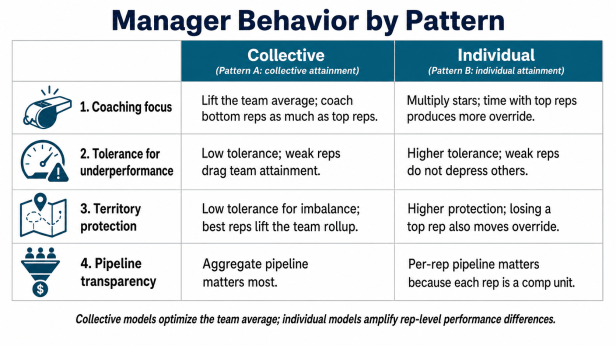
Beyond the dollar math, the two patterns send distinct behavioral signals.
| Behavior | Pattern A | Pattern B |
|---|---|---|
| Coaching focus | Lift the team average. Coaching the bottom rep matters as much as celebrating the top. | Multiply your stars. Time spent with the top rep generates more override than time spent recovering the bottom rep. |
| Tolerance for underperformance | Low. A weak rep drags team attainment. | Higher. A weak rep produces a small override but does not depress the others. |
| Territory protection | Low. Manager wants the best rep in the best territory because it lifts team rollup. | Higher. Manager may resist losing a top rep to another team because the override goes with them. |
| Pipeline transparency | High. Aggregate pipeline is what matters. | High. Per-rep pipeline matters because each rep is a unit of comp. |
| Spike behavior at end of quarter | Manager pushes anyone close to quota; team accelerator is the prize. | Manager pushes individual reps over their individual quotas; each accelerator pays out independently. |
| Hiring incentive | Hire reps who will hit quota. Average matters. | Hire stars and tolerate variability. |
Neither pattern is universally better. Pattern A reinforces team-first cultures and rewards manager development. Pattern B reinforces star-system cultures and rewards manager recruiting. Some organizations use both: a small base team override and a smaller per-rep accelerator, deliberately calibrated to produce a hybrid signal.
Configuring Pattern A in Sales Cookie
Pattern A is the simpler of the two to set up because the crediting and the payout both run against the team as a single unit.
- Create a plan with measurement set to team.
- Define team aliases so transactions credit the right team (territory name, team ID, or any other consistent identifier on the transaction’s “Team or Territory” fields).
- Set the team’s quota at the team level. Use a custom variable on the team if it changes by quarter.
- Define attainment tiers as usual. Tier thresholds are read against the team’s QTD or YTD attainment.
- In the rewards configuration, choose the strategy “assign reward to team manager” rather than “assign reward to credited team members.” This is the override.
- If you have nested team hierarchies (e.g., regional manager owns 3 district managers), enable parent-team rollup so transactions also roll up to higher levels. Configure separate manager-override rewards at each level if you want layered overrides.
Calculation logs will show, line by line, every transaction credited to the team, the team’s attainment, the tier reached, and the override applied to the manager. The manager’s statement reads as one figure (the team’s attainment) plus its derived payout. Auditing is straightforward because there is exactly one calculation per team per cycle.
Configuring Pattern B in Sales Cookie
Pattern B is two plans coordinated, or one plan with split-credit logic. The cleanest way is two plans:
- Create the rep-level plan with measurement set to individual. Reps’ transactions credit their own user records via owner/sold-by fields.
- Define each rep’s quota individually (custom variables on each user, or a quota table).
- Calculate rep commissions as usual.
- Create a second plan, also measurement set to individual, targeting only managers. Crediting on this plan uses a dynamic crediting formula or a custom crediting rule that, for each rep’s calculation, attributes the override to the rep’s manager.
- The reward formula on the manager plan reads each rep’s individual attainment and payout, applies the override percentage, and sums across the manager’s direct reports.
The manager’s statement now shows a list of reps, with each rep’s attainment, each rep’s commission, and the override generated for the manager. This is more transparent for the manager (they can see exactly which rep is driving their comp) and more complex to set up. Calculation logs reference both plans; auditing requires understanding the dependency between them.
Edge cases and the decisions they force
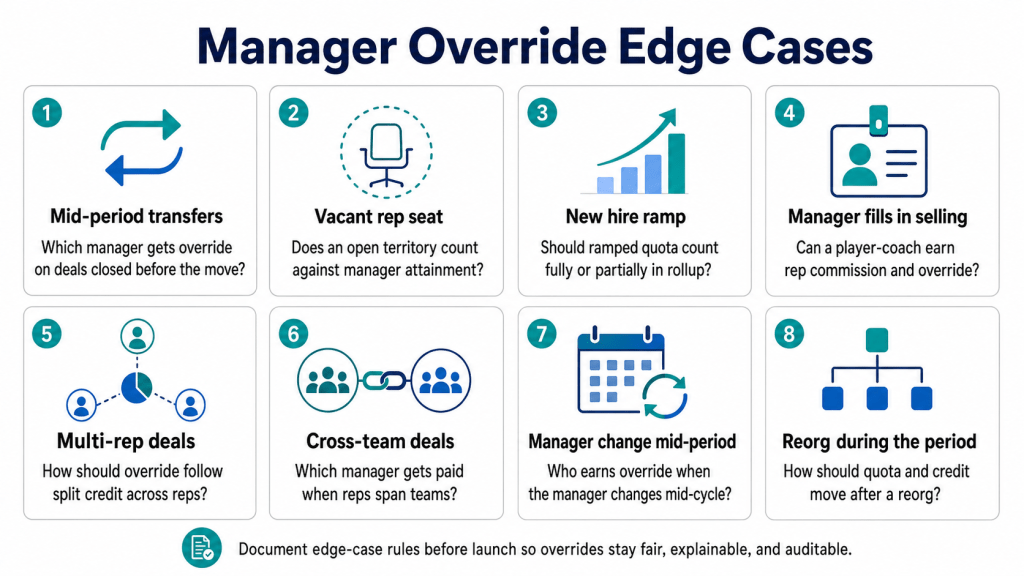
| Edge case | Question | Typical policy |
|---|---|---|
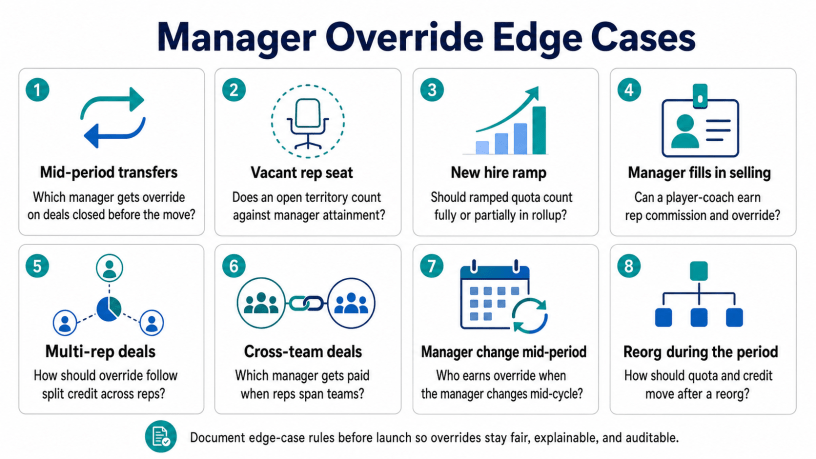
| Mid-period rep transfer | Does the gaining manager or losing manager get the override on deals closed before the move? | Override follows the rep’s manager at the deal’s effective date. Use HRIS effective dates to drive this automatically. |
| Vacant rep seat | Does a vacant territory’s quota count against the manager’s attainment in Pattern A? | Either zero the seat’s quota or prorate it for the time vacant; do not let an open seat distort the rate. |
| New hire ramp | Does a 30 percent ramped quota for a new rep count fully against the manager? | Use the ramped quota for both the rep and the team rollup in Pattern A; let Pattern B’s per-rep model handle it naturally. |
| Manager who also sells | Should the player-coach earn rep commission and team override on the same deal? | Yes for player-coaches by design; configure two plans and document the policy. |
| Cross-team deal | Two reps from different managers split a deal. Whose manager gets the override? | Use Sales Cookie’s crediting splits to allocate each manager their portion; weight via formula if not 50/50. |
| Manager change mid-quarter | A district manager is replaced in February. Who earns Q1’s override? | Prorate by time-in-role using effective-dated team membership; both managers see partial credit on the audit log. |
| Reorg during the period | A team is split into two. How is the manager-level quota redistributed? | Decide explicitly: prorate by member-count, by historical sales, or freeze the original team for the cycle. |
| Player-coach in Pattern A only | Does the manager’s individual sales count toward the team’s collective attainment? | Yes if the manager sits inside the team; this aligns incentives but blurs role clarity for headcount planning. |
Which to use, decision framework
- Use Pattern A (collective) when: your culture rewards team development and coaching, you want managers focused on lifting bottom performers, your span of control is small (3 to 7 reps), or your team-level quota is large enough that the team rollup feels like the natural unit.
- Use Pattern B (individual override) when: your culture rewards individual stars, you want manager comp tied tightly to each rep’s outcome, your span of control is large (10+ reps), territories are fluid and the per-rep override travels naturally, or you want manager comp to be more sensitive to top-performer outcomes.
- Use a hybrid when: you want both signals. A common formulation is 30 to 50 percent of manager variable comp on team rollup and the rest on a per-rep override. The split is the policy lever; both calculations run in parallel and the manager sees both lines on their statement.
Bottom line
The collective and individual manager-override patterns are not interchangeable. They produce different math whenever the team is not perfectly uniform, and they produce very different manager behaviors at every level: coaching, recruiting, territory protection, tolerance for variance. The configuration choice in Sales Cookie is a one-time setting (measurement by team versus by individual, plus the reward strategy) that shows up in every coaching conversation a manager has for the next year. Picking deliberately, and revisiting the choice as the team’s stage and shape changes, is one of the higher-leverage decisions in any sales compensation design.
See both patterns configured side by side. Our team can show you a working collective plan, a working individual-override plan, and a working hybrid in under 30 minutes. Book a personalized demo. Pair this article with our crediting engine deep dive, our crediting vs. payment guide, and our retroactive data and true-ups guide.
Sources: Sales Cookie – How does the crediting engine work; Sales Cookie – Dynamic crediting formulas; WorldatWork on incentive plan design; HBR on sales compensation.

