Reading time: about 15 minutes. The architectural choices that let Sales Cookie automate 99 percent of real-world commission structures, why most competing tools cannot, and the specific edge cases that break them but not us.
Most commission software shops are sold on the demo. The demo always works because the demo is built around the product’s capability envelope. The reality check arrives 90 days into implementation, when the buyer’s actual plan turns out to contain a structural feature the tool cannot express: a per-transaction split that needs a complex formula, not a fixed percentage. A reward strategy that pays a manager based on attainment of individual members, not just on aggregate team credit. A draw that recovers from future commissions only within a defined window, or with caps on repayments. A data pool that mixes Salesforce opportunities with QuickBooks invoices using different field names. The tool’s docs say “yes, we support that” because in the simplest case they do. In the case the buyer actually has, they do not.
Sales Cookie was built from the start to avoid this failure mode. The architecture is designed to take whatever shape your plan has, rather than forcing your plan into the shape of the product. This article walks through the four architectural choices that make that possible, the edge cases that test them, and the questions to ask any vendor (including us) to validate the claim. If your plan involves any of the complications listed here, this is the article that explains why the answer is “yes, we can automate this.”
What “complex” actually means in commissions
Before walking through the architecture, a working definition. Complex commission structures are not just plans with a lot of moving parts. Complex structures share a few specific properties that simple tools cannot represent.
- Non-trivial valuation: Each transaction’s value depends on more than revenue. Margin, points, hours, units, or a formula across multiple fields with cross-data lookups.
- Conditional crediting: Who gets credited depends on the transaction’s product, region, customer segment, or some other complex logic – not just the owner field.
- Asymmetric splits: Two or more parties earn against the same deal in unequal proportions, possibly determined by a split formula.
- Multi-source data: The plan reads from more than one system of record, with different field names representing the same concept, or complex data lookups to correlate records.
- Reward decoupling: The person credited and the person paid are not always the same (overrides, manager bonuses, team rollups).
- Time-varying everything: Quotas change quarterly, rates change annually, reps transfer teams mid-period, plans get redesigned.
- Exception handling: A handful of reps are on custom variants of the standard plan, or have one-off SPIFs layered on top.
Plans with any one of these are common. Plans with three or more are typical above 50 reps. Plans with five or more are universal at enterprise scale. The architectural test for a commission tool is whether it can handle all seven simultaneously, on the same calculation, without hand-coded workarounds.
Architectural choice 1: a pipeline with pluggable logic at every step
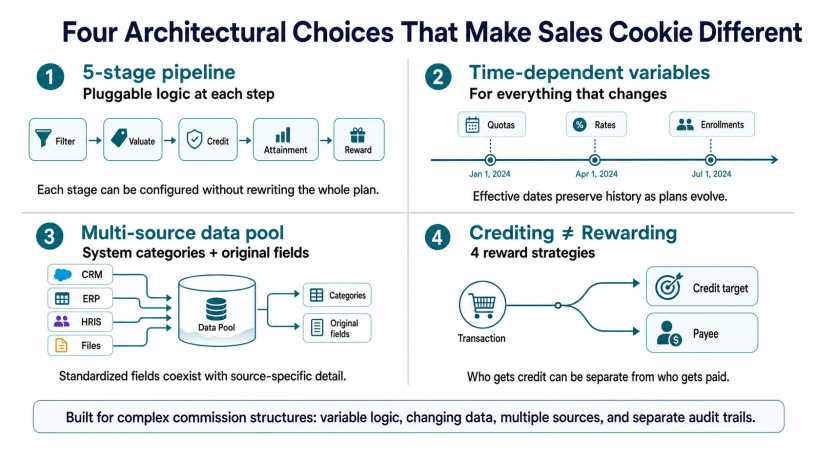
Sales Cookie implements commission calculation as a 5-stage pipeline: Filter, Valuate, Credit, Determine Attainment, Reward. Per the deconstructing post, this matters because “the sad reality is that most commission software products make limiting assumptions about commissions. For example, they assume there will be a per-deal payout which isn’t always the case. Those poorly designed solutions hard-code commission behaviors, which limits flexibility. As a result, they can only automate a small percentage of real-world commission structures.”
The Sales Cookie design choice is that each stage has a default behavior that works for most plans, and a customization hook for the cases where the default does not work. You can write a script at Filter to decide eligibility based on a calculated margin. You can write a formula at Valuate to count appointments instead of revenue. You can write a dynamic crediting rule at Credit to lookup product SKU and decide owner. You can compute attainment as an average call duration rather than a sum. You can layer multiple reward strategies on the same credits at Reward. The pipeline is the structure; the logic inside each stage is yours.
| Stage | Default behavior | Customization available |
|---|---|---|
| 1. Filtering | Apply a saved query (e.g., status = closed AND isPaid = true) | Full script can decide per-transaction eligibility (e.g., margin-based) |
| 2. Valuating | Use revenue field as the deal value | Formula or catalog lookup to compute value from margin, units, points, etc. |
| 3. Crediting | Match owner field to user aliases | Dynamic crediting formula; indirect crediting via territory; explicit splits |
| 4. Attainment | Sum of deal values vs. quota | Average, count, rank, or arbitrary formula |
| 5. Rewarding | Apply tier table to attainment to compute payout | Multi-band accelerators, SQL queries against credited transactions, custom formulas, manager and team reward strategies |
Why this matters: Most competing tools expose one or two of these customization points and hard-code the rest. The plans they can automate are then limited to those that fit the hard-coded shape. Sales Cookie exposes all five, which is why the same engine can handle a per-deal AE commission plan and a points-based SDR plan and a margin-based product-line bonus and a tenure-based team rollup, all in the same workspace.
Architectural choice 2: time-dependent variables for everything that changes
Commission programs change constantly. Quotas reset each quarter or year. Rate tables get adjusted. Reps join teams, leave teams, and get promoted mid-period. Plans get redesigned annually. Most tools treat plan parameters as static fields, which means every change either requires editing the plan in-place (and corrupting historical calculations) or cloning the plan (and creating a maintenance nightmare).
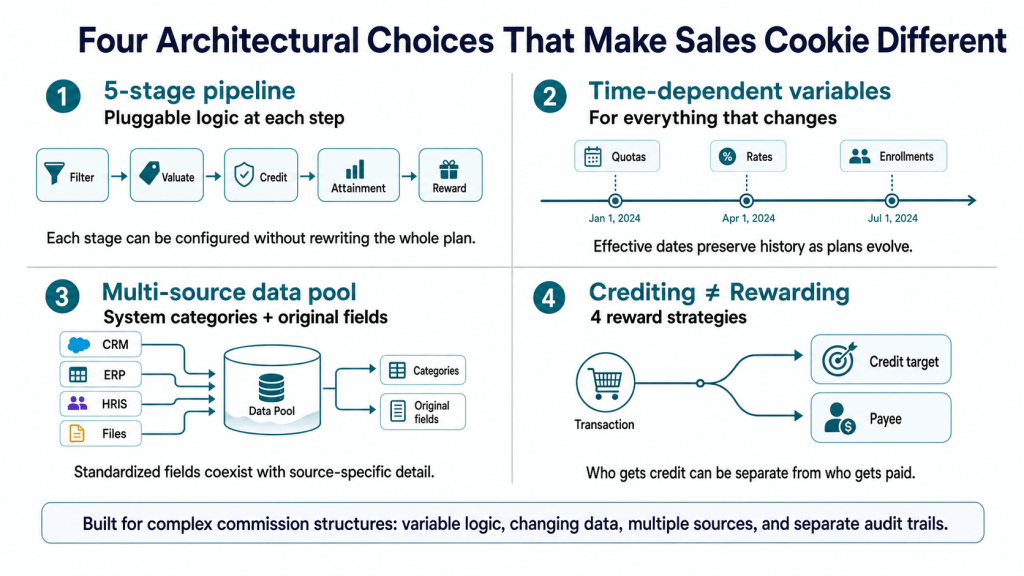
Sales Cookie models every commission-related number as a time-dependent custom variable. A variable like @@Quota holds different values for different periods, and the engine automatically pulls the right value for the period being calculated. You define the values once, in a single place, and refer to the variable name everywhere. When the value changes, the calculation for old periods does not change, but the calculation for the new period uses the new value. Same applies to plan eligibility, team membership, role assignment, and any custom attribute you want to attach to a user or team.
The practical impact: a rep who transitions from SDR to AE in mid-Q2 is on the SDR plan up to the transfer date and the AE plan from the transfer date forward, without any plan cloning or special-case logic. The Q2 calculation automatically produces the correct credit and payout split.
Architectural choice 3: a multi-source data pool that unifies field names
Real commission programs read from more than one data source. SDRs are paid on booked appointments from a CRM. AEs are paid on closed-won opportunities from Salesforce. Renewal reps are paid on invoices from billing. Channel reps are paid on partner-submitted deals from a separate system. Each source has its own field names. Salesforce calls the deal value “Amount.” QuickBooks calls it “Total.” A CSV from the SDR tool calls it “ARR.” All three represent the same concept, but no two are named the same.
Per the multi-source data documentation, Sales Cookie stores transactions in a data pool that supports both views simultaneously. You can refer to the original field name from a specific source (“Amount (Imported)” from Salesforce), or you can refer to a system category that unifies fields across sources (“Revenue (System)” which resolves to Amount in Salesforce, Total in QuickBooks, or ARR in the CSV). Two views, one underlying transaction pool. Same approach applies to dates, owners, customer identifiers, and any other field you map.
| Data source | Field name | System category | In logic |
|---|---|---|---|
| Salesforce report | Amount | Revenue | “Amount (Imported)” or “Revenue (System)” |
| QuickBooks invoices | Total | Revenue | “Total (Imported)” or “Revenue (System)” |
| SDR tool CSV | ARR | Revenue | “ARR (Imported)” or “Revenue (System)” |
| HubSpot deals | DealValue | Revenue | “DealValue (Imported)” or “Revenue (System)” |
| Stripe charges | AmountCharged | Revenue | “AmountCharged (Imported)” or “Revenue (System)” |
Why this matters: An SDR-plus-AE plan can read appointments from one source and opportunities from another, both filtered, credited, and rewarded in the same calculation run, without forcing the data to be normalized upstream. Plans that need only one source still work. Plans that need three sources work too. There is no “ETL before commission” project blocking implementation.
Architectural choice 4: separation of crediting from rewarding
The fourth and arguably deepest architectural choice is that the credited party and the paid party are two independent decisions on each transaction. Sales Cookie supports four reward strategies, mapping onto the four organizational realities of who earns from a deal: credit-user-pay-user (standard rep plan), credit-user-pay-manager (individual-attainment manager override), credit-team-pay-team-members (team rollup), credit-team-pay-team-manager (collective-attainment manager bonus). The same transaction can produce credits and payments under multiple strategies in parallel.
This separation, covered in detail in our crediting vs. payment article, is what lets a single closed-won deal produce a rep commission, a manager override, and a team SPIF without double-counting attainment or corrupting ASC 606 amortization schedules. Tools that conflate crediting with rewarding force the buyer to choose: get the rep payout right and break the override math, or get the override right and break attainment reporting. Sales Cookie does not force the choice.
The edge cases that test the architecture
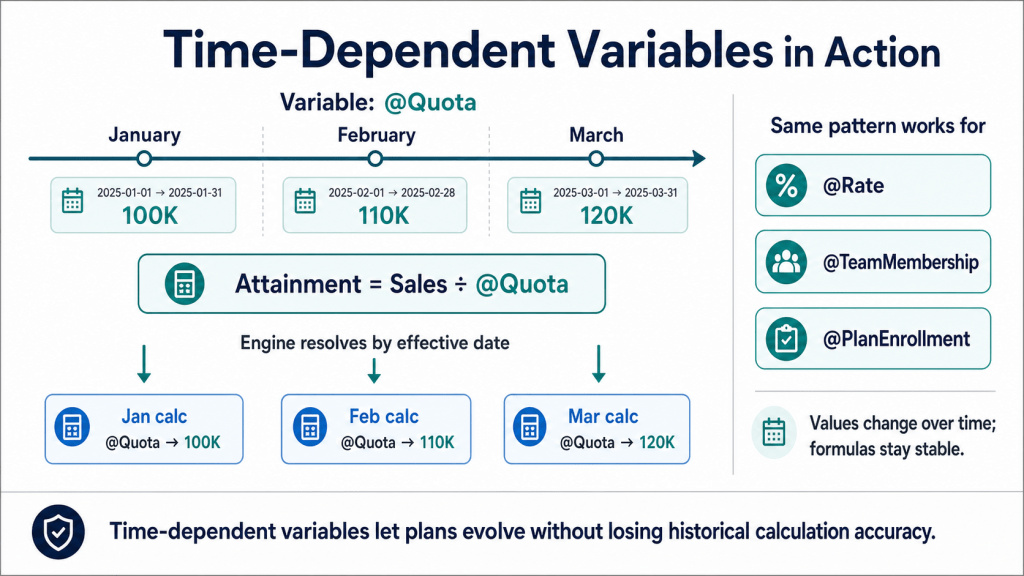
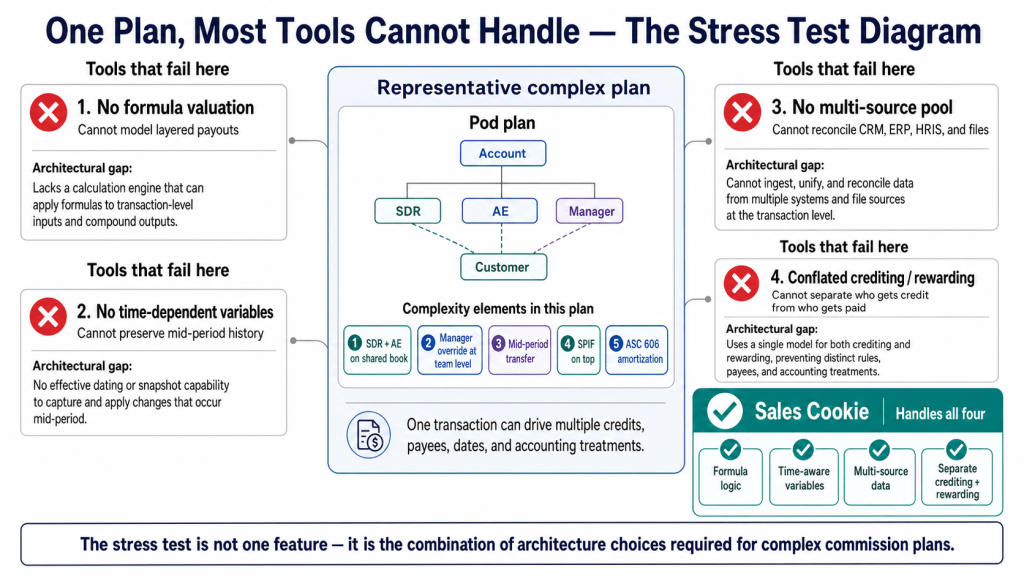
Below are the specific structural cases that come up in real plans and that test each of the four architectural choices. If your plan contains any of these, the question to ask any vendor (including us) is exactly which mechanism handles it.
| Edge case | Architectural mechanism that handles it |
|---|---|
| Pay reps based on appointment count not revenue | Valuate stage: custom formula returns 1 per record instead of revenue |
| Pay reps on margin not revenue, with margin computed per deal | Valuate stage: formula computes margin from cost and price fields |
| Different reps split the same deal at different ratios | Credit stage: dynamic crediting formula with explicit weights (e.g., user1[0.4];user2[0.6]) |
| Pay one rate for closed-won, another for invoice-paid | Two plans: Estimated plan triggers on close, Due plan triggers on payment (pay-when-paid pattern) |
| Quota changes quarterly per rep | Time-dependent variable @@Quota with values per period per rep |
| Mid-period team transfer needs cross-team credit split | Effective-dated team membership variable; calculation produces split automatically |
| Manager paid on individual rep attainment, not pooled | Reward strategy: credit-user-pay-manager (individual attainment override) |
| Manager paid on collective team attainment, separate pool | Reward strategy: credit-team-pay-team-manager (collective attainment override) |
| SDR + AE shared book where both earn on each deal | Reward strategy: credit-team-pay-team-members on a team containing both |
| Reading appointments from CRM and opportunities from Salesforce in same plan | Multi-source data pool with system-category mapping |
| Different field names for revenue across sources | System category “Revenue” maps to ARR / Amount / Total / DealValue from each source |
| Retroactive deal arriving 3 months after the period closed | YTD recalculation produces true-up; see retroactive sales data article |
| Custom GL account per plan for ASC 606 export | Custom variable on plan; OData API exposes for finance pull |
| Per-deal SPIF on top of standard plan, only for a specific quarter | Effective-dated additional plan layered on the same data |
What we cannot do (the honest list)
We do not claim 100 percent of commission structures, only 99 percent. There is a small set of cases that are genuinely outside what Sales Cookie automates today, and it is worth being honest about them.
- Highly bespoke approval workflows with multi-level, escalation-driven, or conditional approval logic better served by a general workflow tool (Nintex, K2). Core approval workflows are built in; exotic variants are not. Advanced workflows require reminders, escalations, multi-party approval, etc.
- Long-tail HR-system integrations for write-back of commission data into proprietary HRIS payroll modules. We mostly export cleanly; we do not push. However, custom integration is always available if you need this (at cost).
- Real-time per-deal payout calculations on sub-second SLA. The pipeline is very fast (parallel processing on Azure), but it is designed for periodic calculation runs, not for sub-second event-driven response. Many plans require re-evaluating YTD attainment (i.e. tens or hundreds of thousands of records processed), or complex rules.
If your plan needs all three of these, we are honest about being a poor fit. For the rest, the architecture handles it. The reason is the four choices above, working together.
Three questions to ask any vendor
When you are comparing commission vendors, the demo always looks fine. The interesting answers come from these three questions. Ask each, listen to the answer, and note where the vendor hesitates.
- “Show me the calculation pipeline. Where can I plug in custom logic at each stage?” If the answer is “you cannot, but our standard logic covers most cases,” you are looking at a tool that will hit a wall on your edge cases.
- “How do you handle a rep who transfers teams mid-quarter and earns under two different plans for the same period?” If the answer requires plan cloning, manual data entry, or a “workaround,” you are looking at a tool without effective-dated variables.
- “How do you handle a deal that needs to credit the rep for attainment but pay the manager for the override, without double-counting?” If the answer is “we put the manager in the rep’s plan as a second commissionable party,” walk away.
The bottom line
Most commission tools optimize for the demo. Sales Cookie optimizes for the implementation. The four architectural choices (a pipeline with pluggable logic at every step, time-dependent variables, a multi-source data pool with system categories, and separation of crediting from rewarding) are why the same product can automate a 25-rep SaaS shop and a 2000-rep multi-region enterprise. If your plan has any of the complications listed in the edge-case table above, this is why the answer is yes.
Bring us your gnarliest plan. Bring the one that broke the last tool. Bring the edge case nobody else could handle. Book a demo with a real plan document, real data, and the strangest exception you have. We will tell you exactly which mechanism handles it, or we will tell you honestly if it is one of the three we cannot.
Related reading
- Why it is crazy not to automate commissions
- Our process to automate your commissions
- The huge ROI of commission software
- Inside a crediting engine
- Crediting vs. payment
- Retroactive sales data and true-ups
Sources
- Sales Cookie, Deconstructing sales commission software
- Sales Cookie KB, How is multi-source transaction data handled?
- Sales Cookie KB, How does the crediting engine work?
- Sales Cookie KB, Dynamic crediting formulas (advanced)

