Reading time: about 13 minutes. A 60-day operating schedule from final plan design through launch day, written for the Sales Ops or RevOps lead who owns the next comp year.
The companies that launch new commission plans well share three habits. They start the rollout 60 days before launch, not three weeks. They communicate in cascading waves, not one all-hands. And they treat plan acknowledgement as a contract, not a calendar reminder. The companies that launch poorly do something fundamentally different: they finalize the plan in a vacuum, ship it on day one of the new fiscal year, and spend the rest of Q1 fighting fires. This guide is the schedule that prevents the second outcome.
Why 60 days, not 30
WorldatWork and Mercer benchmarks consistently show that high-performing comp programs lock the plan design 8 to 10 weeks before launch. Most plans rolled out in less than 30 days have something we will diplomatically call “issues” by week six: misunderstood accelerator math, undocumented split rules, miscalculated quotas, or rep acknowledgement signatures collected after the first deal of the year already closed. None of these problems are about plan content. They are about rollout timing.
The 60-day window also matches what change-management research has been saying for decades. Kotter’s eight-step framework, Prosci’s ADKAR model, and similar frameworks all observe that adults need repeated exposure across multiple contexts before behavior changes. A plan launched on January 2 with one all-hands on December 30 has not given any rep enough exposure to actually change selling behavior. A plan introduced in waves over eight weeks has.
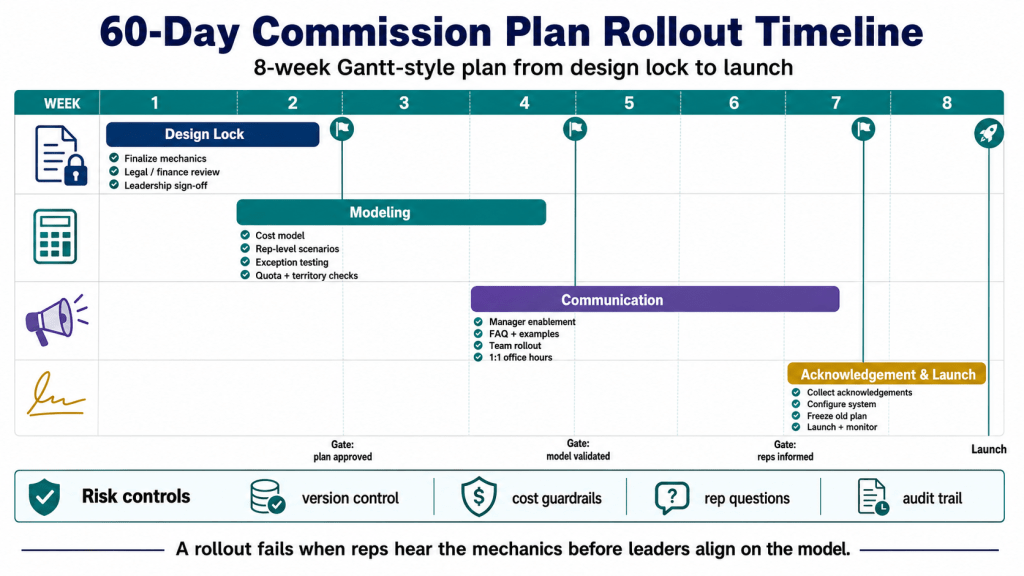
The 60-day schedule at a glance
| Week | Phase | Primary deliverable | Owner |
|---|---|---|---|
| Week -8 | Design lock | Final plan structure approved by CRO and CFO | Sales Ops + Finance |
| Week -7 | Modeling | Plan modeled at 50 / 100 / 150 percent attainment scenarios | Sales Ops |
| Week -6 | Modeling | Total comp expense projection signed by CFO | Finance |
| Week -5 | Documentation | Plan document drafted, examples worked, FAQs assembled | Sales Ops + Legal |
| Week -4 | Communication | CRO presents plan to sales managers; manager-level training begins | CRO + Sales Ops |
| Week -3 | Communication | Managers run 1:1s with their reps; questions logged centrally | Sales managers |
| Week -2 | Acknowledgement | Plan documents distributed; rep portal opens; signatures begin | Sales Ops |
| Week -1 | Acknowledgement | All signatures collected; territories and quotas assigned in tooling | Sales Ops |
| Week 0 (Launch) | Live | FY plan effective; first deals counted under new plan | All |
Phase 1: Design lock (Week -8)
Design lock is the single most important moment in the calendar. After this date, the plan structure is closed. Any further changes require CRO and CFO re-approval. This is the discipline that keeps the rollout from drifting.
Design lock should produce three artifacts: a one-page plan summary per role (AE, SDR, CSM, channel), a master decision log of every plan change debated and decided, and a list of any open items deferred to Q2. Anything that is not in these three artifacts cannot quietly appear in the final plan.
Phase 2: Modeling (Weeks -7 to -6)
Modeling is where most plan disasters are caught before they happen. Run the plan against the prior year’s actual bookings at three attainment scenarios:
- 50 percent attainment. Confirms the plan does not over-pay underperformers due to a too-low threshold or a too-generous draw.
- 100 percent attainment. Confirms total comp expense at on-target equals the budget the CFO signed.
- 150 percent attainment. Confirms accelerators and overachievement payouts do not blow the comp budget if the year goes well.
The output should be a rep-by-rep modeling spreadsheet with columns for prior actual comp, projected new-plan comp at each scenario, and the delta. Reps with a delta greater than 15 percent (in either direction) need conversation before launch, not on day 30 of the year.
Phase 3: Communication (Weeks -5 to -3)
The cascade matters as much as the content. CRO communicates to managers first, then managers to their reps, then Sales Ops follows up with documentation and tooling access. Every stage of the cascade gives reps the same message from someone they trust.
| Wave | Audience | Format | Goal |
|---|---|---|---|
| Wave 1 (Week -5) | Sales managers | CRO-led 90-min session + Q&A | Managers must be able to defend the plan |
| Wave 2 (Week -4) | Manager training | 2 sessions, 60 min each, scenario-based | Train managers on edge cases and plan math |
| Wave 3 (Week -3) | Reps via 1:1s | 30-min manager 1:1 with each rep | Personal context: quota, territory, plan changes |
| Wave 4 (Week -2) | All-hands sales | CRO + Sales Ops, 60-min recorded session | Reinforce the message; address common questions |
| Wave 5 (Week -1) | Reps individually | Plan portal + acknowledgement | Documented signature on individualized plan |
The pattern works because reps hear the new plan from their manager privately before hearing it from the CRO publicly. By the time the all-hands happens, no rep is surprised. Surprise is the enemy of plan acceptance.
Phase 4: Acknowledgement and launch (Weeks -2 to 0)
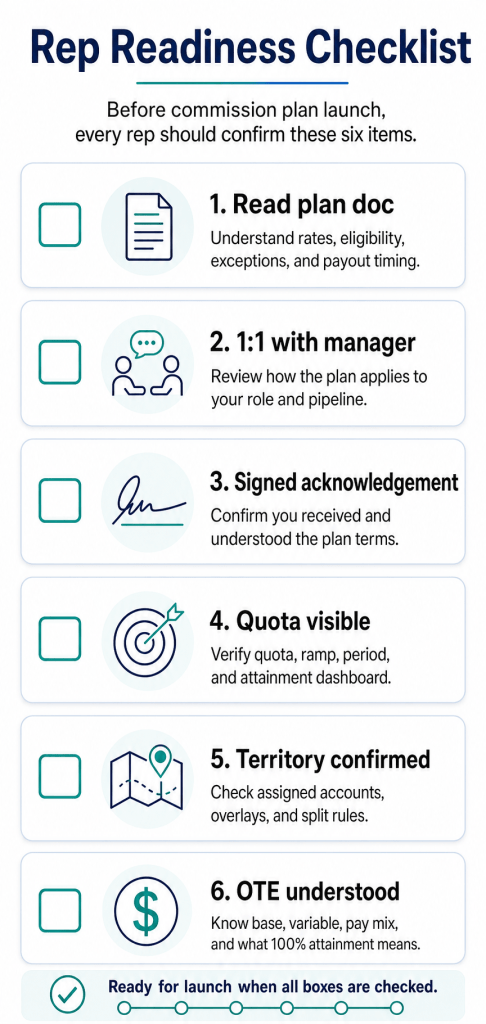
The acknowledgement step is non-negotiable for two reasons. First, in many U.S. states (notably California, New York, and Illinois) commission plans must be in writing and signed before they can be enforced. Second, an explicit signature kills the most common rep dispute: “I did not understand the rule.” If they signed it, they understood it. Their disagreement is captured separately, in writing, in the dispute log.
The acknowledgement portal should present the rep with: their personalized plan summary (role, segment, quota, OTE, accelerators, special conditions), the full plan document, the FAQ, and an electronic signature. The system should flag any rep who has not signed by the close of Week -1, and the CRO should personally call any unsigned rep on day -1.
RACI for the rollout
| Activity | Responsible | Accountable | Consulted | Informed |
|---|---|---|---|---|
| Plan structure design | Sales Ops | CRO | CFO, Sales managers | Reps |
| Comp expense modeling | Sales Ops | CFO | FP&A | CRO |
| Quota setting | Sales managers | CRO | Sales Ops, FP&A | Reps |
| Plan document drafting | Sales Ops | Legal | HR, Finance | CRO |
| Manager training | Sales Ops | CRO | Enablement | Reps |
| Rep 1:1 communication | Sales managers | CRO | Sales Ops | HR |
| Acknowledgement collection | Sales Ops | CRO | Legal, HR | CFO |
The 12 rollout risks worth tracking
The same dozen failure modes show up in rollout postmortems year after year. Tracking them as a risk register during the 60 days catches each one before it ships.
- Quota numbers were finalized after design lock and no one ran the modeling against them.
- Territories changed in the last week and CRM was not updated to match.
- Plan document is silent on at least one motion (renewal, upsell, expansion). Reps will discover the gap during the first deal.
- Accelerator math and decelerator math are inconsistent. Reps will discover this on the first big deal.
- Currency or multi-entity reps were missed.
- Channel and direct reps got the same plan; no one thought through partner credit.
- Acknowledgement portal does not work on mobile and 30 percent of reps cannot sign on day -1.
- Comp tooling was not configured to reflect the new plan; first month commissions are calculated by hand and disputed.
- The rep who is now a manager has been forgotten in the plan.
- Mid-year hires have no transition rule from old plan to new plan.
- The plan was translated to one language but the team has reps speaking three.
- The CRO is unavailable for the unsigned-rep call on day -1 and someone else has to make it.
What to measure post-launch
The first 90 days post-launch are the proof. Track four metrics, weekly:
- Acknowledgement coverage. Should be 100 percent before day 0; should remain 100 percent as new hires onboard.
- Dispute volume. Compare disputes per 100 statements to last year’s first 90 days. A successful rollout cuts this in half.
- Plan-related FAQ traffic. Week 1 high, falling to baseline by week 6. If volume rises in week 4, the plan has an unaddressed ambiguity.
- Rep attrition tied to comp. If exit interviews mention plan disagreements, the rollout did not fully succeed even if the launch was clean.
Bottom line
A great commission plan launched poorly will look like a bad plan. A merely-okay plan launched well will look like a great plan. The difference is rarely the plan; it is the rollout. Eight weeks, four phases, five communication waves, and a non-negotiable acknowledgement step is the operating model that consistently works. Most other patterns are just shorter versions of the same thing, with predictable consequences.
Manage your next plan rollout in one system. Sales Cookie handles modeling, plan documents, acknowledgement portal, and rep-level statements end-to-end. Pair this guide with our commission structures guide and our commission nightmares roundup.
Sources: WorldatWork Sales Compensation Programs and Practices; SHRM on sales compensation simplicity; Prosci ADKAR change management; Kotter 8-Step framework.

