Reading time: about 13 minutes. The complete anatomy of why commission disputes happen, the eight root causes that account for most of them, the workflow that handles disputes cleanly, and how to cut dispute volume in half.
Disputes are the rep-trust tax of any commission program. Every dispute, even one resolved in the company’s favor, costs hours of finance and ops time, eats manager focus, and slowly erodes the rep’s belief that the system is fair. The good news is that dispute frequency is not random. Most companies see the same eight root causes accounting for roughly 80 percent of dispute volume, and a small set of operational changes cut that volume meaningfully. This guide walks through the anatomy.
How often disputes actually happen
Industry surveys put the baseline rate at 4 to 8 disputes per 100 commission statements in well-run programs, and 15 to 25 per 100 in programs operated on spreadsheets. Salesforce’s State of Sales 2024 reports that more than 60 percent of reps have experienced commission errors in the previous 12 months, and Harvard Business Review has documented that uncertainty about commission outcomes is one of the strongest predictors of voluntary rep turnover. Disputes are also seasonal: Q1 is always the worst quarter because new plans take effect, territories realign, and reps notice payout differences against the prior plan.
The eight dispute root causes
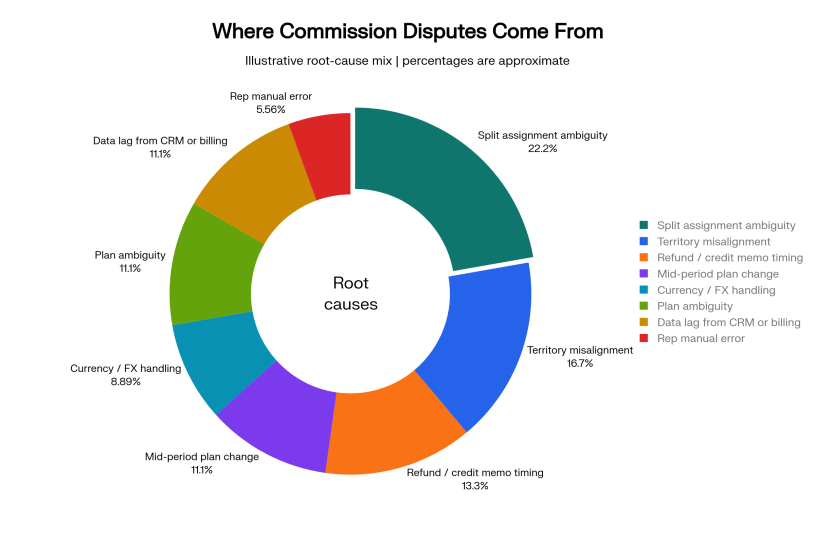
Across hundreds of programs, the same eight categories account for the vast majority of disputes. Recognizing the category is the first step to fixing the cause.
| Root cause | Typical share of disputes | Where it shows up |
|---|---|---|
| 1. Split assignment ambiguity | ~20% | Multi-rep deals where credit allocation is unclear |
| 2. Territory misalignment | ~15% | Account moves that crossed quarter-end |
| 3. Refund or credit memo timing | ~12% | Customer refund processed after commission paid |
| 4. Mid-period plan change | ~10% | Plan adjusted after deals were already in pipeline |
| 5. Currency or FX handling | ~8% | Multi-currency deals with wrong conversion rate or date |
| 6. Plan ambiguity | ~10% | Plan document silent on the specific scenario |
| 7. Data lag from CRM or billing | ~10% | Deal closed but not yet reflected in source system on cutoff date |
| 8. Rep manual error | ~5% | Rep miscounted or misread their own statement |
The categories add up to roughly 90 percent of the volume. The remaining 10 percent is a long tail of one-off issues. Note that root cause 6 (plan ambiguity) is itself a sign of a documentation problem upstream, and root cause 4 (mid-period plan change) is almost entirely preventable.
The formal dispute workflow
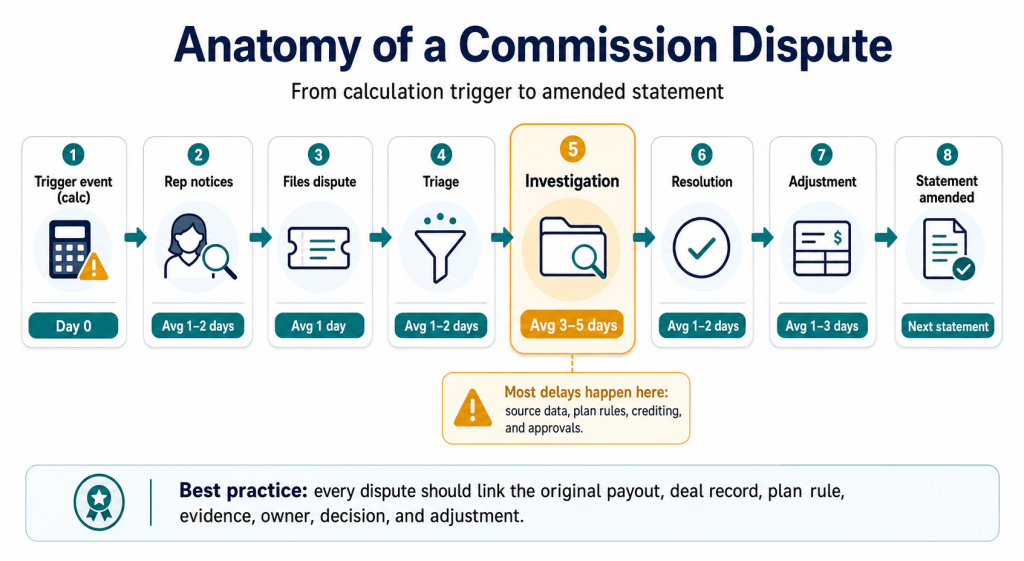
A defensible dispute process has four stages, each with a service-level agreement. Without SLAs, disputes drift, reps escalate to leadership, and the process collapses into ad hoc handling.
| Stage | SLA | Owner | Output |
|---|---|---|---|
| Intake | Acknowledged within 1 business day | Sales Ops | Ticket created with deal reference and category |
| Triage | Within 3 business days | Sales Ops | Root cause classified; quick-fix or investigation |
| Investigation | Within 7 business days | Sales Ops + manager + Finance | Decision documented with evidence |
| Resolution & pay | Posted to next statement | Sales Ops + Payroll | Statement adjustment with audit trail |
The fastest dispute response is the one that does not need investigation because the system already shows the rep how the calculation was made, with deal-level traceability. Many disputes vanish the moment a rep can see “this deal contributed $X because of accelerator tier 2, applied because attainment passed 110 percent on this date.” If the statement only shows a final number, every difference becomes a dispute.
Pre-detection: catching disputes before reps file them
The most effective single change a Sales Ops team can make is to run anomaly detection on the statement before it goes to the rep. The check is simple in concept: compare each rep’s statement to recent norms, flag outliers, route flagged statements to manual review. The math is unglamorous; the impact is significant. Companies running pre-flight review on statements consistently report a 40 to 60 percent reduction in formal disputes filed because most “this looks wrong” moments are caught before the rep ever sees the statement.
Pre-detection should flag any statement where:
- Total commission jumped or dropped more than 30 percent versus the rep’s trailing 3-month average without an obvious driver.
- A specific deal’s credit was split with more than two other reps.
- An accelerator triggered but the underlying threshold deal closed within the last 5 days of the period.
- A clawback would push the rep’s net statement negative.
- Currency conversions used a non-standard rate.
- A territory change was processed within 14 days of the period close.
Pre- vs. post-automation: realistic dispute volumes
| State | Disputes per 100 statements | Avg resolution time | Typical drivers |
|---|---|---|---|
| Spreadsheet-only | 15 to 25 | 10 to 20 days | Manual entry errors, version drift, no audit trail |
| Automated, no pre-detection | 8 to 12 | 5 to 10 days | Rules consistent; ambiguity and split issues remain |
| Automated + pre-detection | 3 to 6 | 2 to 5 days | Edge cases only; outliers caught before rep sees |
| Automated + statement traceability + pre-detection | 2 to 4 | 1 to 3 days | Reps can self-investigate; only true issues escalate |
The post-dispute analytics layer
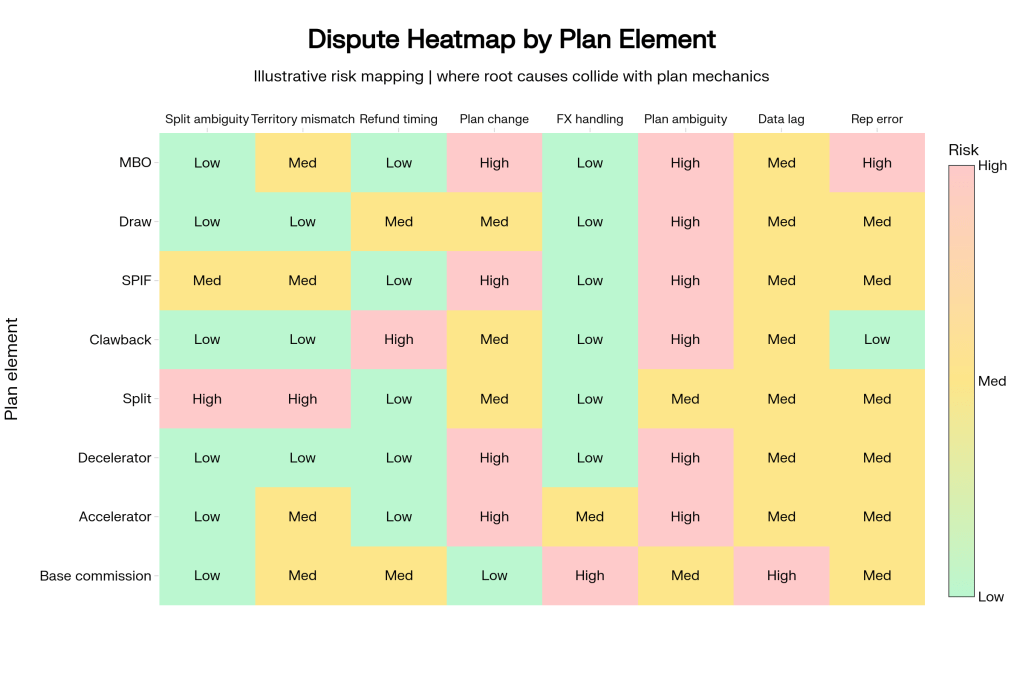
Most teams stop after resolving a dispute. The high-performing teams treat dispute data as a feedback loop into plan design and operations. Every quarter, run an analysis with three questions:
- Which root cause categories are growing? Rising split-assignment disputes mean territory or roles changed and the plan did not catch up. Rising plan-ambiguity disputes mean the plan needs an addendum.
- Which reps generate disproportionate disputes? Sometimes the rep is right and the system is consistently wrong on their accounts. Sometimes the rep is exhibiting a pattern that needs management attention.
- Which managers’ teams generate disproportionate disputes? Often a sign the manager has not aligned reps to the plan, or has been promising things off-plan.
Communication patterns that defuse disputes
How a dispute is communicated matters as much as the math. Three principles:
- Acknowledge first, investigate second. A rep who feels heard is patient with a 7-day investigation. A rep whose ticket sits without acknowledgement files a second one or escalates to the CRO.
- Cite the plan section. Every resolution must reference the specific plan provision. This converts “your interpretation versus mine” into “the contract says X.”
- Pay the adjustment promptly. If the dispute is decided in the rep’s favor, the adjustment goes on the very next statement. Delays in paying out look adversarial.
What good looks like in numbers
A 50-rep B2B SaaS company running a healthy dispute program looks like this. Dispute volume sits at 3 per 100 statements. Average resolution time is 3 business days. Pre-detection flags about 8 to 10 statements per cycle for review, of which roughly half are corrected before the statement is published. The dispute log is reviewed quarterly with categories tagged. The plan document is amended at the next planning cycle to address the top two root cause categories. Reps see disputes resolved on the next statement with a citation to the plan section.
The mistake that produces most disputes
Most of the dispute volume in the typical B2B company traces back to a single upstream choice: the company chose to communicate the new plan as a 30-minute slide presentation rather than a 60-day rollout (covered in our commission plan rollout playbook). The compounding cost across the year, in finance time, manager time, rep time, and rep trust, is large. The discipline that prevents most of this is upstream of any dispute software.
The Bottom line
Disputes are a measurable, manageable problem. The 80 percent rule applies: eight root cause categories, four-stage workflow, two operational changes (pre-detection and statement traceability), one upstream investment (rollout discipline). Companies that internalize this end up with rep statements that ship cleanly, finance teams that close on schedule, and reps who trust the math.
See dispute volume drop in the first month. Sales Cookie uses AI pre-detection to flag anomalies before statements are published, with full traceability so reps can self-investigate. Pair with our AI for dispute reduction piece and our commission nightmares roundup.
Sources: Salesforce State of Sales 2024; Harvard Business Review on sales force management; Gartner Sales research; SHRM on commission plan simplicity.

