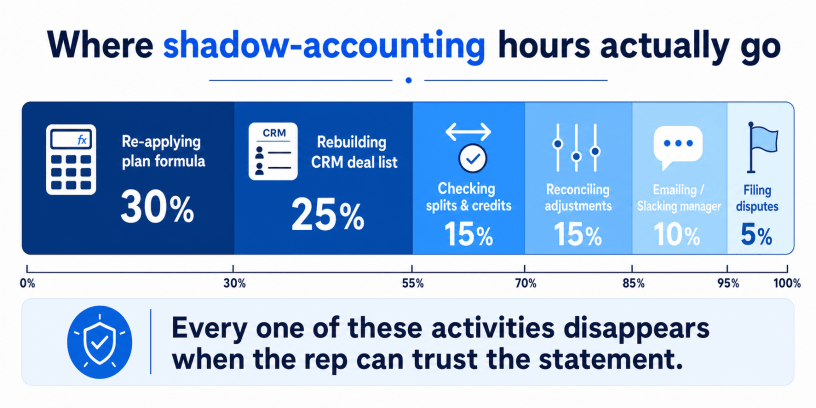
Reading time: about 10 minutes. Sales Cookie’s own research shows 62 percent of reps run shadow-accounting spreadsheets to verify their commissions, and the industry cost lands between 2 and 4 hours per rep per week. This article explains why shadow accounting happens, why it is expensive even when it goes unspoken, and the five-step program that ends it.
Shadow accounting is what happens when a rep does not trust the commission number the company sends them. It usually starts as a personal spreadsheet with a list of that rep’s closed deals, a copy of the plan rules the rep interpreted for themselves, and a running total the rep believes they are owed. When the company’s number arrives, the rep compares it to their own. If the two agree, the rep files the statement and moves on. If they do not, the rep opens a dispute.
The trap is that shadow accounting is not a story of a few disgruntled reps. Sales Cookie’s own interview data reports that 62 percent of representatives use shadow accounting to verify payouts. Independent industry data referenced on the Sales Cookie University page puts the time cost at 2 to 4 hours per rep per week. That is not a compensation problem or an HR problem. It is an operating cost with a specific dollar figure that every finance leader can calculate for their own team.
What shadow accounting actually looks like
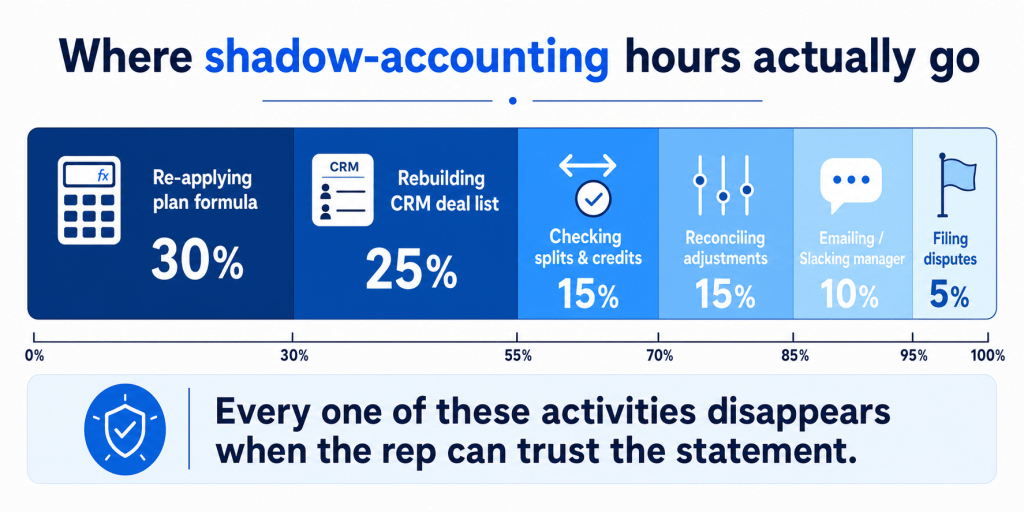
In its most common form, shadow accounting is a rep’s personal spreadsheet containing four columns: the deal (from the CRM), what the rep thinks the deal is worth in commission dollars, what the company paid, and the delta. Some reps go further and rebuild the plan formula in the spreadsheet, tier by tier, so they can predict future payouts. A minority track cumulative attainment against quota, cross-check accelerator thresholds, and simulate SPIF and MBO outcomes. All of it happens in Excel, Google Sheets, or a Notion table that the rep maintains privately.
Managers rarely see these spreadsheets. Finance almost never does. And that is the first thing that makes shadow accounting a problem: it operates as a parallel system to the company’s official commission process, generating its own version of the truth, without any of the controls, audit, or reproducibility that the official process is supposed to have.
Why reps shadow-account: five root causes
Reps do not shadow-account because they enjoy it. They do it because something has convinced them that the company’s number cannot be taken on faith. Five specific triggers explain almost every case.
| Trigger | What it feels like to the rep | Underlying cause |
|---|---|---|
| Prior error, even a small one | “They got it wrong once. Never again.” | Trust is asymmetric; one visible error prompts persistent verification behavior. |
| Opaque statement | “I have no idea how they got to that number.” | Statement shows totals without underlying detail; see our manager override workflow piece. |
| Silent adjustments | “An unexplained line appeared. Why?” | Adjustments without reason codes or approvers on the statement. |
| Restated periods | “Last month said one number. This month says another.” | Prior-period statements not preserved and not diffed. |
| Plan ambiguity | “The plan does not clearly say what I get for this deal.” | Splits, credit basis, or accelerator rules not fully specified. |
The pattern beneath all five triggers is the same: the rep does not have a way to reproduce the company’s calculation from the source data. Once a rep loses the ability to verify a payout, the only rational fallback is to build their own verification system.
Sizing the cost in your own P&L
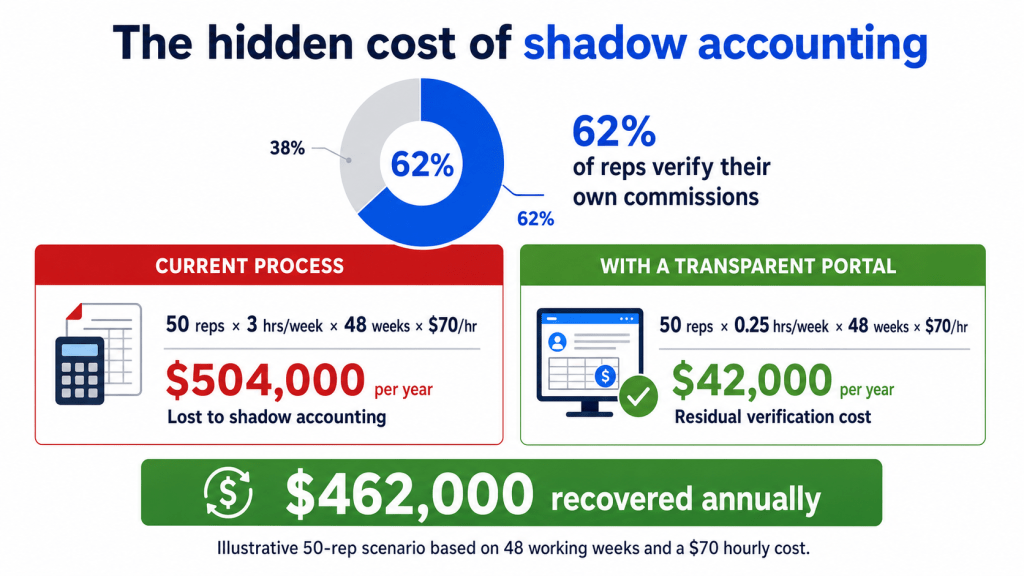
Shadow accounting is one of the few sales-ops problems with a clean back-of-envelope calculation. Multiply four numbers.
| Input | Example | Where to find it |
|---|---|---|
| Commissioned headcount | 50 reps | Sales roster; include AEs, AMs, CSMs with quota, SEs on quota |
| Hours per rep per week on shadow accounting | 3 hours | Industry range 2-4; use 3 as a mid-case |
| Working weeks per year | 48 | 52 minus PTO/holidays |
| Fully loaded hourly cost | $70 | OTE + benefits divided by ~2,000 productive hours; for a $150K OTE rep this is roughly $75 |
| Annual shadow-accounting cost | $504,000 | 50 × 3 × 48 × $70 |
Half a million dollars per year is not an accounting anomaly. It is a real productivity loss that the sales organization is absorbing invisibly, because shadow accounting time is time not spent prospecting, presenting, negotiating, or closing. And unlike most productivity losses, it is not accidental. It is systematic and repeat.
The number is also probably conservative. Sales Cookie’s homepage benchmarks (from a survey of 86 North American SMB sales management professionals) report 62 percent of reps engaging in shadow accounting. The 3-hour weekly figure is a middle-of-the-road estimate. Enterprise reps with complex plans (multi-year deals, splits, ramps, MBOs, quota relief) frequently exceed 4 hours per week during quarter-close periods.
The five-step program that ends shadow accounting
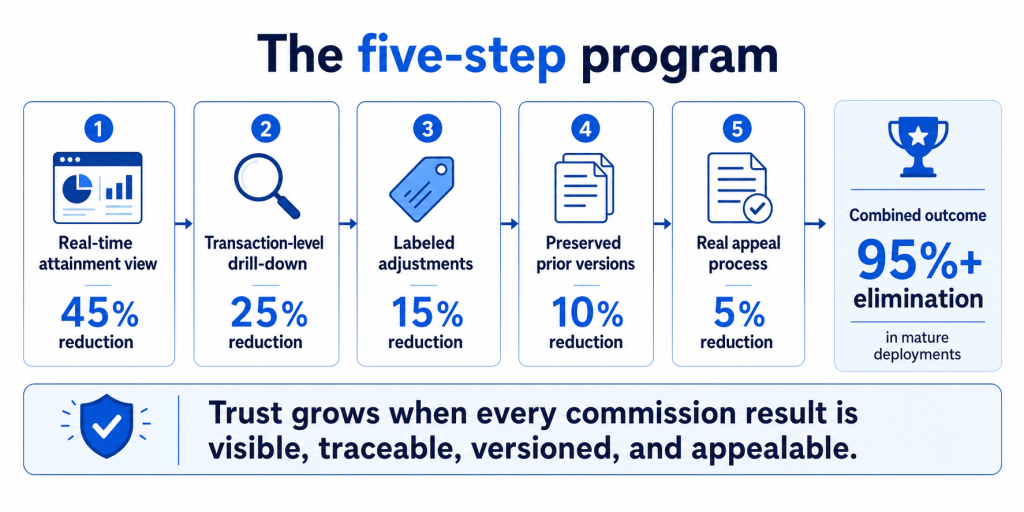
Ending shadow accounting is not a single fix. It requires a specific sequence of changes that together make the company’s number reproducible, current, and trustworthy. When any one step is missing, reps keep their spreadsheets open just in case.
Step 1: Publish a real-time attainment view
The rep should see their current attainment, projected end-of-period attainment, and expected payout at any time, from any device, without asking anyone. This alone reduces shadow accounting by roughly half in most companies, because it eliminates the “what am I on track for” spreadsheet.
Step 2: Expose transaction-level detail with drill-down
For every deal on the statement, the rep should see the deal ID, customer, close date, deal amount, credit basis (revenue, ACV, margin, whatever the plan uses), split percentage, applied rate, and commission earned. Each of those should link back to the source transaction in the CRM. If the rep has to leave the statement to check any of these values, shadow accounting persists.
Step 3: Label every adjustment
SPIFs, MBOs, manager overrides, clawbacks, and prior-period true-ups each need a type, an amount, a reason code, and an approver on the statement. Silent adjustments are the single fastest way to re-trigger shadow accounting even after all other steps are in place.
Step 4: Preserve prior versions on any restatement
When a period is restated (because a refund fired, a split was corrected, an approval landed late), the prior version should remain viewable with a labeled diff. The rep should never open a period they have already seen and find a different number with no explanation.
Step 5: Build a real appeal process into the statement
Even in a well-designed system, some payouts will be wrong or unclear. Every statement should include the appeal window, the person to contact, and the resolution timeline. A defined process reduces the emotional cost of raising a concern, which makes reps more likely to raise issues formally instead of maintaining a growing shadow spreadsheet.
Behavioral economics: why “just trust us” does not work
Two well-documented behavioral effects explain why shadow accounting is so resistant to management assurances alone.
Loss aversion. Kahneman and Tversky’s prospect theory research established that people weight losses roughly twice as heavily as equivalent gains. An underpaid commission feels roughly twice as bad as an overpaid one feels good. Reps rationally invest more effort in preventing underpayment than in identifying overpayment, which is exactly why shadow accounting persists even when the average payout is accurate.
Trust asymmetry. Trust takes years to build and moments to lose. One visible commission error in a rep’s tenure produces sustained verification behavior long after the underlying process has been fixed. Sales operations leaders often underestimate how long the trust deficit outlives the technical fix. A published error log and a formal remediation announcement help; a promise that “it will not happen again” does not.
The practical implication: rebuilding trust after a period of shadow accounting requires visible mechanisms, not verbal reassurance. Every one of the five steps above is a visible, reproducible mechanism that a skeptical rep can inspect for themselves.
The uncomfortable side of ending shadow accounting
Companies that end shadow accounting sometimes find something unexpected: the shadow spreadsheets were catching real errors. When the transparent statement goes live and reps stop maintaining private spreadsheets, the underlying calculation had better be right, because there is no longer a second layer of catch. This is why steps 1 through 5 above must be paired with the overpayment-prevention controls covered in our retroactive corrections and crediting engine pieces. A transparent statement on a broken calculation loses trust faster than an opaque statement on a broken calculation, because the errors are now visible.
The good news is that the same platform features that end shadow accounting (transaction drill-down, labeled adjustments, preserved history) also strengthen the underlying calculation, because errors surface immediately and get corrected in the same cycle instead of accumulating quietly.
The five-question shadow-accounting audit
- If we asked our reps privately how many maintain their own commission spreadsheets, what percentage would say yes?
- Can a rep answer “how much am I making this month” without contacting anyone?
- Can a rep trace every line on their statement back to a CRM deal in one click?
- When a period is restated, do reps see the prior version and a diff?
- Is there a documented appeal process with a timeline, communicated on the statement itself?
Answering “no” to more than one of these is roughly equivalent to saying “our reps are running shadow accounting and we are paying for it in productivity.”
What to do next
Shadow accounting is the largest hidden productivity loss in most sales organizations, and it is one of the easiest to eliminate because the fix is a set of platform features and disciplines rather than a comp-plan overhaul. If you want to see how Sales Cookie’s rep portal implements the five steps in this article, and what a “before and after” looks like for a typical mid-market team, book a 30-minute demo. Bring a rough headcount and OTE range and we will size your shadow-accounting cost during the call.
Related reading
- The sales commission statement: anatomy, templates, and best practices
- Sales commission disputes: anatomy and prevention
- Inside a crediting engine
- Retroactive corrections and true-ups
- Manager override workflow
- How to assess your commission setup
- The huge ROI of commission software
Sources and notes
- Sales Cookie research: 62 percent of representatives use shadow accounting to verify payouts; based on interviews with 86 North American SMB sales management professionals. Referenced on the Sales Cookie homepage.
- Sales Cookie University: 2-4 hours per rep per week lost to shadow accounting. Sales Cookie University.
- ICM Report reference: 89 hours per month spent calculating commissions manually, cited on the Sales Cookie University page.
- Industry 2024 sales trends reference: 78 percent of leaders say reps cannot fully understand their plans, cited on the Sales Cookie University page.
- Behavioral economics: Kahneman and Tversky, Prospect Theory: An Analysis of Decision under Risk (Econometrica, 1979).
- Trust and error asymmetry: Harvard Business Review, Motivating Salespeople.
- Spreadsheet error rates in shadow-accounting spreadsheets themselves: Raymond Panko, “What We Know About Spreadsheet Errors”.
- Statistics and references current as of June 2026.

