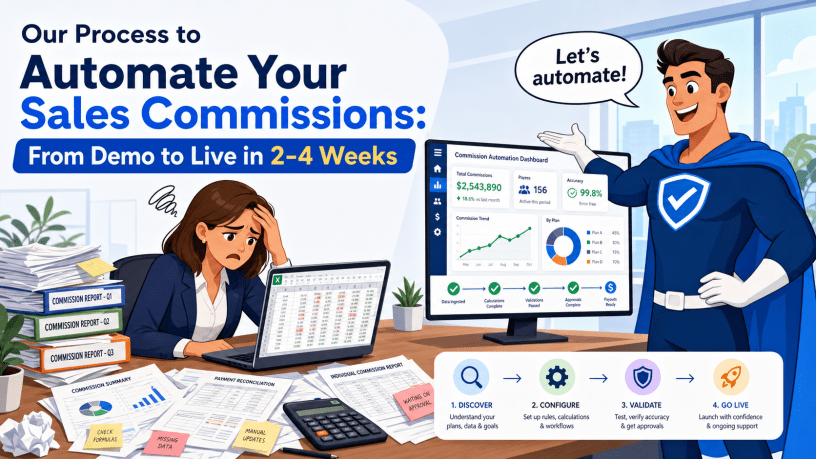
Reading time: about 11 minutes. A step-by-step walkthrough of how Sales Cookie takes your commission program from intake to live calculations, with what we do, what we ask of you, and the timing at each stage.
Most commission software vendors will sell you a license and hand you a knowledge base. You will then spend the next six months trying to configure your own plans, getting stuck on edge cases, and quietly questioning whether the project is going to succeed. Sales Cookie is built around a different model: a guided seven-stage process where our commission experts do the configuration, you do the validation, and you go live on real calculations in weeks, not quarters.
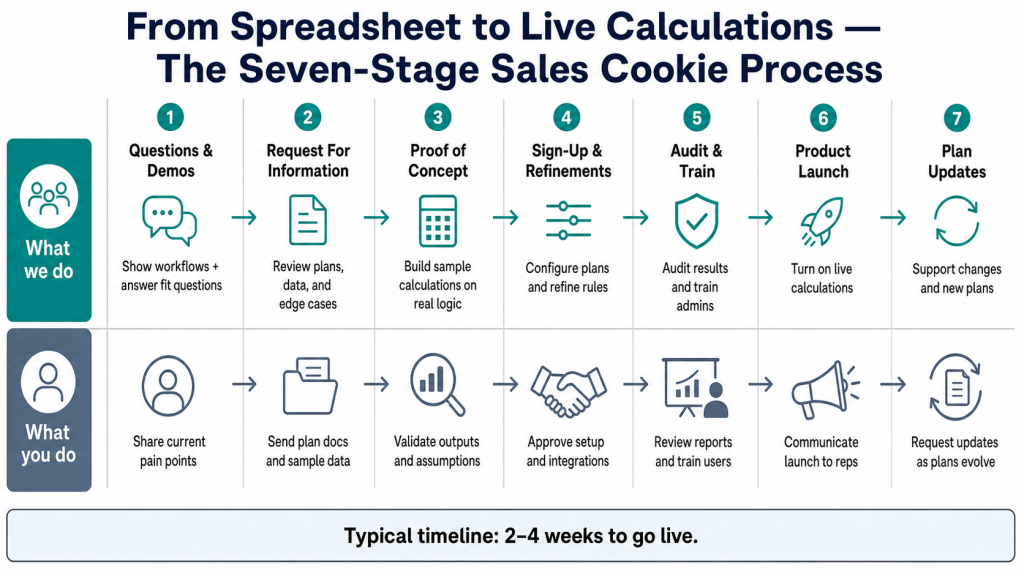
This article walks through the seven stages of our standard process: questions and demos, request for information, proof of concept, sign-up and refinements, audit and train, product launch, and plan updates. Each stage has a clear purpose, a defined output, and a realistic timeline. If you are evaluating commission software, knowing the implementation path matters at least as much as the feature list. A great product behind a painful implementation is a bad deal.
Stage 1: Questions and demos
The process starts with a 30 to 45 minute conversation. You book the demo on our website. Our team of commission experts walks through the product, but more importantly, walks through your situation. We are listening for the shape of your commission program: how many reps, how many plans, how many data sources, what makes your structure unusual, what specifically broke about your current process. We are not trying to sell software in this call. We are trying to understand whether what you need is something we know how to handle.
By the end of the demo you should have answers to three questions: Can Sales Cookie automate the kind of plan we run? What would the rep experience look like for our team? What is the realistic implementation effort to get there? If the answer to any of those is no, we will tell you. We would rather pass on a poor fit than spend three months trying to bend the product to a use case it does not serve.
Stage 2: Request for information
Once we have a working sense of fit, we ask you to document your plans. We provide a standard intake form (online or as a downloadable document). The intake form captures the structural facts of each plan: who is enrolled, what the quota is, what the commission rate or rate table looks like, what triggers payment, what splits or overrides apply, and crucially the exceptions and special cases. Most commission programs have a handful of edge cases that the named plan document does not cover, but everyone in sales-ops knows about. Surfacing them now is much cheaper than discovering them in production.
We also ask for sample data, or read-only access to the systems where your sales data lives. Common sources include Salesforce, HubSpot, QuickBooks Online, Stripe, Chargebee, Xero, and Microsoft Dynamics. CSV upload is always available as a fallback. We are looking for enough data to recreate a representative calculation period (typically one quarter), not a full data migration.
| Stage | What we do | What you do | Typical time |
|---|---|---|---|
| 1. Questions and demos | Demo Sales Cookie, listen to your program | Book the call, describe your situation | 30 to 45 minutes |
| 2. Request for information | Provide intake form, review plan docs | Document plans, share sample data | 3 to 5 business days |
| 3. Proof of concept | Configure POC using your rules and data | Review POC, give directional feedback | 5 to 10 business days |
| 4. Sign-up and refinements | Implement full plans, plan by plan | Subscribe (first month), review each plan | 2 to 4 weeks total |
| 5. Audit and train | Run test calcs, iterate on edge cases, train admins | Audit calculations against expected payouts | 1 to 2 weeks |
| 6. Product launch | Enable rep logins, final validation support | Invite payees, validate via real users | 1 week |
| 7. Plan updates | Simple updates free, quote for plan redesign | Tell us what changed | Ongoing |
Stage 3: Proof of concept
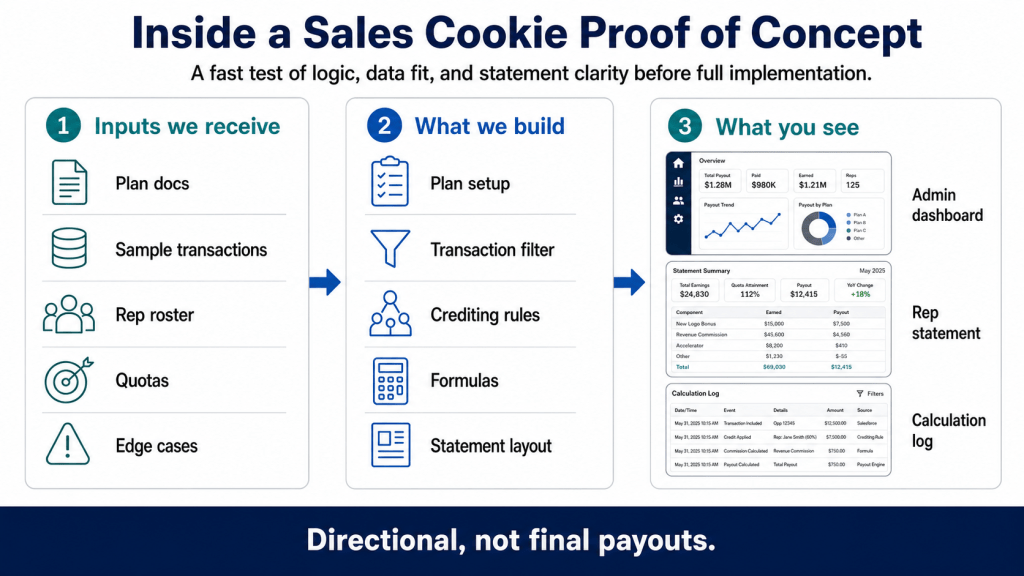
This is the stage that separates Sales Cookie from most commission tools. Our team configures a meaningful proof of concept using your actual rules and your actual data. We do not hand you a template and wish you luck. We do the configuration work, then walk you through the result. The POC typically takes 5 to 10 business days from receipt of intake forms and sample data.
One important thing to know: the POC is directional. We are not yet trying to match your historical payouts to the dollar. We are demonstrating that the rules are expressible, the data flows correctly, the rep statements look right, and the overall structure is sound. Expect the POC payouts to be in the right shape but not in the right value, because we have not yet tuned every edge case or matched every data source date boundary. That tuning is what Stage 4 and Stage 5 are for.
Stage 4: Sign-up and refinements
If you like what you saw in the POC, the next step is a one-month subscription. We then implement all your plans for real. Important detail: your first plan configuration is free. For additional plans, we provide a quote up front. If you have many plans, we work incrementally, one plan at a time, so you can validate each before moving on. This is intentionally cautious; it prevents the failure mode of a “big bang” launch where five plans all go live at once and an edge case in plan three corrupts the calculations across all of them.
At this stage we are also wiring up the data integrations for real. The sample data from the POC is replaced with live connections (Salesforce sync, QuickBooks pull, Stripe webhook, or a scheduled CSV import depending on the source). Crediting rules are validated against real users, real teams, and real transaction owners using the alias matching covered in our crediting engine article.
Stage 5: Audit and train
Now the calculations have to match. We run test calculations for a closed historical period (typically last quarter) and ask you to audit them against the payouts you actually issued. This is an iterative process. The first run will surface differences. Some will be us misunderstanding your rules; some will be edge cases that were never explicit in the plan document. Either way, we iterate. We tune the configuration, you re-audit, we repeat. Usually two or three iterations gets to clean match.
Once the calculations match, we train you on admin operations: how to run a calculation, how to review the audit log, how to handle a dispute, how to add or remove a rep, how to update a quota. Admin training takes a couple of hours and gives you the operational autonomy to run the system day-to-day. We stay available for plan changes (Stage 7), but you should be able to run a close week without us.
Stage 6: Product launch
This is the moment you invite your payees to log in. Each rep gets credentials and access to their personal dashboard with goals, statements, transactions credited to them, and payout history. The rep experience is one of the most-cited reasons customers move off spreadsheets. Reps stop emailing finance with statement questions because the answer is on their dashboard.
Launch is also a final validation. With reps now in the system looking at their own numbers, any remaining edge case will surface within a week. Two-thirds of customers find one or two small adjustments to make in this window. Almost no customer finds a structural problem; that was caught in Stage 5.
Stage 7: Plan updates
Commission programs do not sit still. New quotas every year, new SPIFs every quarter, new product lines, new territories, occasional structural redesigns. Sales Cookie tracks all plan changes with effective dates, so a rep who transitioned to a new team mid-Q2 still gets calculated correctly across the boundary. Simple updates (new quotas, new rates, new enrollments) are usually free of charge. For complex changes (plan redesign, new commission model), we provide a quote.
Plan updates are the stage that lasts forever, which is the point. Implementation is a project; running commissions is a process. Our goal is to make the project as short as possible so the process is what you spend your time on.
The questions buyers ask us most about implementation
| Question | Honest answer |
|---|---|
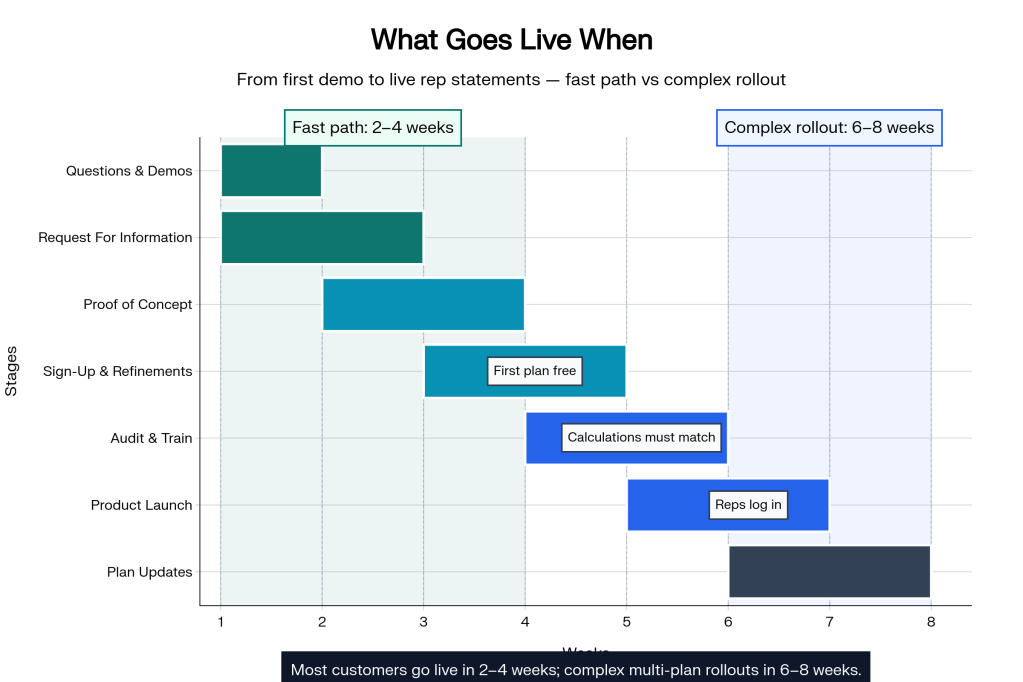
| How long until we are live? | Most single-plan rollouts: 2 to 4 weeks. Multi-plan rollouts with several data sources: 6 to 8 weeks. |
| Do we have to clean our data first? | No. The alias system absorbs naming inconsistency across systems; see our crediting engine article. |
| Do you configure the plans or do we? | We do. Your first plan is free; additional plans are quoted. You can also self-configure later. |
| What if our plan changes mid-implementation? | Common. Effective-date variables let us model the change cleanly without restarting. |
| Will the POC payouts match our historical numbers? | Not exactly. POC is directional. Stage 5 audit is where calculations are tuned to match. |
| Who pays for the SPIF redesign we do every quarter? | Simple changes are free; structural plan redesigns are quoted. |
| What happens if we hate it after the first month? | Cancel. The first month is intentionally short-term so the decision to continue is yours. |
What we ask of you to make this work
Three things from the buyer side make the whole process faster.
- One internal owner. A single person responsible for filling out the intake form, providing data access, and signing off on the audit. The implementation goes slower without it.
- Honest exception inventory. Tell us about the weird cases. The one-off override your VP approved last year. The handful of reps on a custom plan. The mid-period transfer of the SDR team. We can model anything if we know about it; we cannot model what is kept secret.
- Real data, not toy data. The POC and the audit both need representative data. Toy data hides the cases that will break in production.
What you get at each stage, summarized
- After Stage 1: A clear go/no-go decision on whether Sales Cookie fits your structure.
- After Stage 2: A documented intake of your plans, captured in a form we can configure against.
- After Stage 3: A working POC running on your rules and data.
- After Stage 4: All your plans implemented and connected to live data sources.
- After Stage 5: Test calculations matching your expected payouts to the cent, and your admin team trained.
- After Stage 6: Every rep logged in, dashboards live, statements visible.
- Stage 7 onward: A running system, with simple updates handled free of charge.
The next step
Book a demo. Bring your messy plan document, your strangest edge case, and one quarter of data. We will walk through the implementation path for your specific situation and tell you honestly whether it is a fit. Book here.
Related reading
- Why it is crazy not to automate commissions
- Why only Sales Cookie can handle the most complex commission structures
- The huge ROI of commission software
- How to evaluate commission software vendors
Sources
- Sales Cookie KB, Our Work Process
- Sales Cookie KB, How does the crediting engine work?
- Sales Cookie, Deconstructing sales commission software

