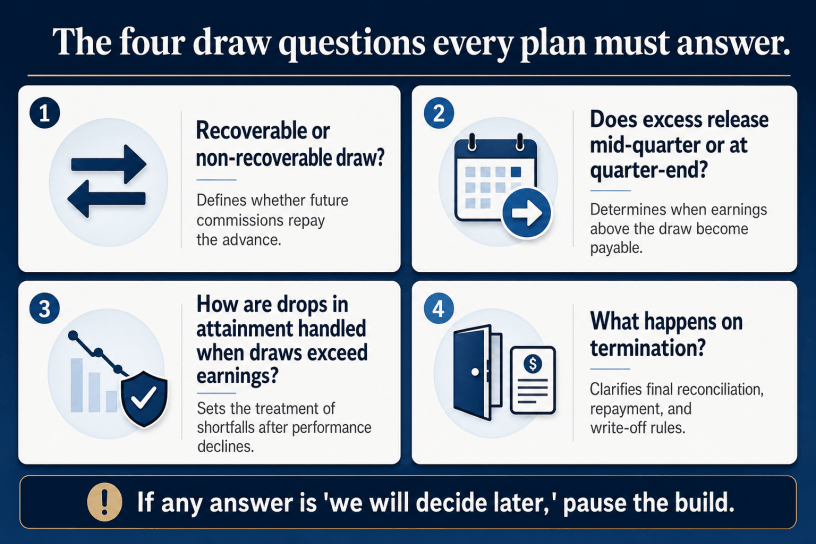
Reading time: about 12 minutes. This is a field report from a recent large-scale Sales Cookie deployment. Names, companies, geographies, and plan specifics have been anonymized. What remains are the twelve patterns that show up in almost every complex rollout, and the practices that separate a fast implementation from a slow one. If you are about to onboard a commission program with multiple plans, multiple currencies, and multiple stakeholders, read this before your kickoff.
Commissions are messy. That is not a failure of a company or a tool. It is the natural state of a program that sits at the intersection of sales, finance, HR, legal, and the CRM. Every rollout uncovers rules that were never written down, edge cases that only surface when a real deal touches them, and disagreements between stakeholders who did not realize they disagreed. The job of a good implementation is not to pretend that mess does not exist. It is to make the mess visible early, decide on it once, and encode the decision so it survives quarter-close, plan changes, and staff turnover.
What follows are twelve lessons drawn from a recent deployment that covered several countries, multiple currencies, a subsidiary structure, draws paid on a different cadence from the scorecard, and a mix of standard and non-standard plan mechanics. Each lesson is presented in the same shape: what happened, why it caused rework, and what a clean pattern looks like in Sales Cookie. Read this as a checklist for your own program.
Lesson 1. Internal communication is the number one silent risk
The single most expensive category of rework on this deployment was not a technical problem. It was that decisions made by one stakeholder were not shared with the rest of the team. The implementation team would build a plan based on the instructions from the primary sponsor, and then a different stakeholder, sometimes days later, would surface a change that had already been decided but had not been communicated. The plans then had to be adjusted, sometimes at the level of individual assignments and payouts.
The lesson is not “communicate more.” It is that a commission program needs a single owner of the plan spec, and that owner needs to hold a running document that every stakeholder edits in one place. If two stakeholders send conflicting instructions to the implementation team, the last-write-wins pattern that happens by default is almost always wrong. In Sales Cookie, the practice we recommend is a shared plan brief that is versioned, dated, and reviewed by every named signer before the first payroll is calculated. The brief lists every plan component, every assignment rule, every quota, and every exception, and each item has one and only one decision-owner.
Lesson 2. Pick your source of truth for currency conversion once
The deployment agreed early to use a standard FX rate table for all currency conversions. Partway through Q2, the team discovered that one plan was still using the FX conversion produced by the CRM opportunity record instead of the agreed-upon rate table. The two sources disagreed by enough that some deals crossed accelerator thresholds under one method and not the other.
Currency conversion is one of the most common places where two apparently identical numbers turn out to be different. The CRM records a dollar amount on the day the opportunity was created or last edited. The finance rate table records a rate on the last day of the month or the last day of the quarter. The bank’s actual received amount reflects the settlement date. Any of the three can be defensible; only one can be canonical. The lesson is to write the rule down before you touch a single plan: “commission calculations use the finance rate table as of the last day of the reporting period, and the CRM amount is used only to identify the deal, never to compute the payout.” Once this is decided, wire it into the Sales Cookie source configuration and forbid mixing.
Lesson 3. One-off cases will always exist. Force them into scope before build
Every deployment we have seen produces a category of deal or rep that no one thought to describe until the build was already underway. In this rollout, one-off cases were surfaced incrementally, and each one caused the plan logic to become slightly less stable, because a rule written for the general case had to be extended to accommodate the exception. After several rounds, the logic was doing so much special-casing that it became hard to reason about.
The correct pattern is to explicitly ask, in the kickoff workshop, “what deals or reps do not follow the standard plan.” Ask twice. Ask the sales leader, the finance lead, and the CRM admin separately. The list of exceptions that comes back is almost always incomplete, but the act of asking three times catches most of what would otherwise arrive late. Then, in Sales Cookie, encode each one-off as its own named rule, with a start date, an end date, and a written justification, so the exception never silently persists into a future quarter.
Lesson 4. Role reclassification is a plan change, treat it like one
Midway through the program, one senior role that had been categorized as a standard sales manager was reclassified late in the quarter as needing its own plan. The team had to unwind the existing setup and build a fresh plan for a single person, then reconcile the periods that had already been processed under the old assignment.
Role reclassification is one of the most disruptive changes a commission program can absorb, because it invalidates assignment rules, quota tables, and any period that has already been calculated. The lesson is to make role reclassification a plan-change event with the same governance as a plan version bump: it requires a written justification, a sign-off, and an effective date, and any prior period that touched the old classification is explicitly flagged for review. The related discipline is our plan design principles piece on writing plan documents that survive turnover.
Lesson 5. Non-standard draws are a design decision, not a shortcut
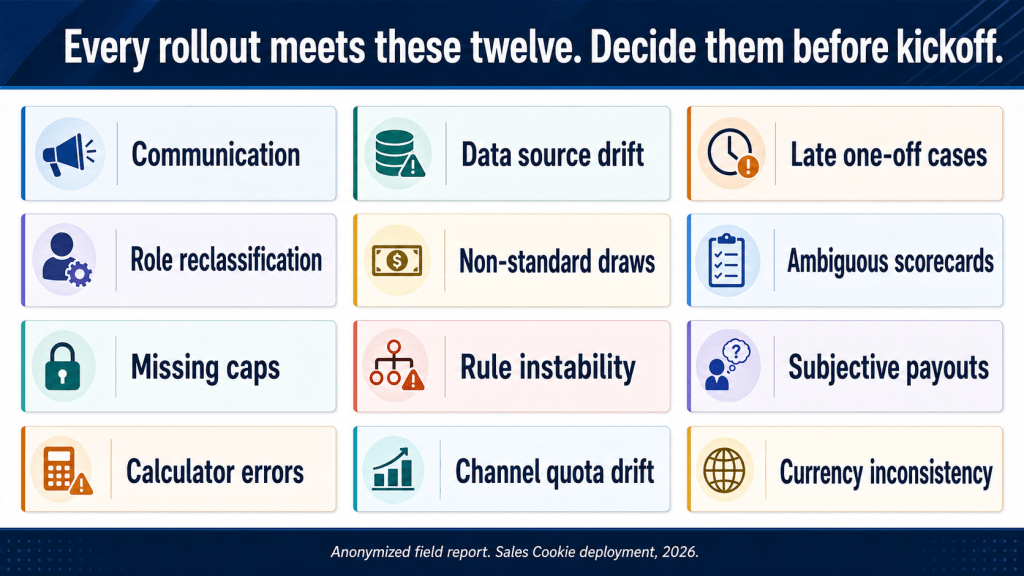
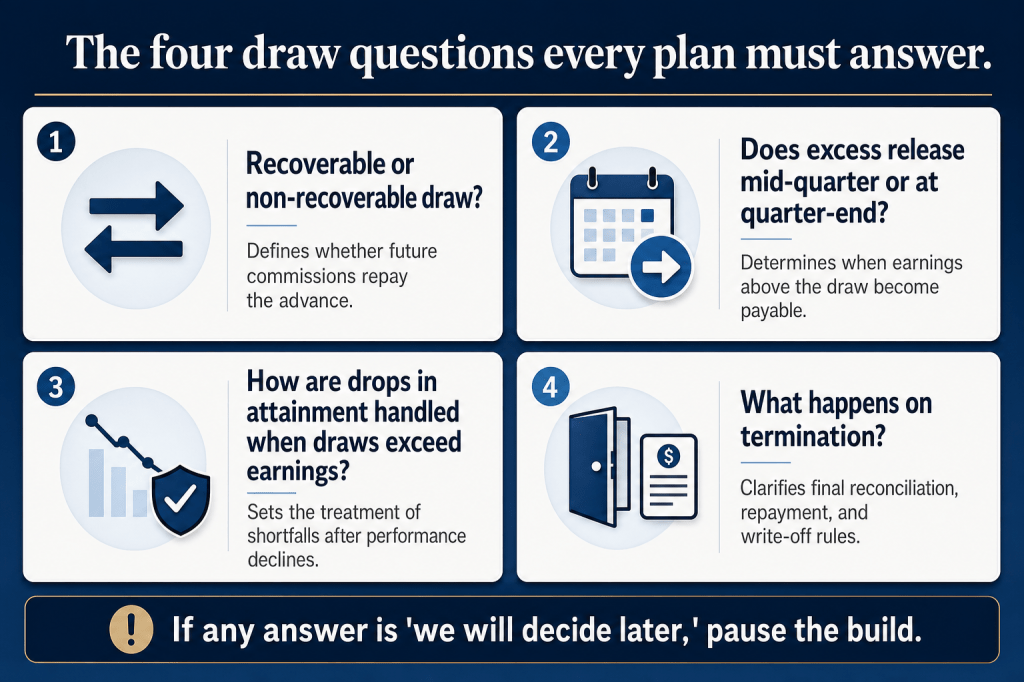
This deployment had draws paid monthly against a scorecard paid quarterly, where the rep receives the higher of the two. The mechanic is defensible: monthly draws smooth cash flow for the rep, and the quarterly scorecard captures true performance. But the interaction between the two creates edge cases. If a rep receives a draw in month one and month two, and then their quarterly scorecard is lower than the sum of the draws they have already been paid, is the rep expected to repay? If a rep exceeds the draw during the quarter, is the excess paid or held? Even the customer’s own team was not fully aligned on the answers.
| Draw scenario | Key Question | Sales Cookie Implementation |
|---|---|---|
| Monthly draw is $5,000 and quarterly scorecard is $12,000 | Is the quarterly scorecard the true earnings, and the draws are advances against it? | A reconciliation rule at quarter-end that nets prior draws against the scorecard payout. |
| Monthly draws sum to $15,000, quarterly scorecard is $12,000 | Is the rep required to repay the difference, or is the draw non-recoverable? | A recoverable-versus-non-recoverable draw flag on the plan component. |
| Rep earns above the draw during the quarter | Is the excess released immediately or held to quarter-end? | A release timing rule on the scorecard component. |
| Rep leaves mid-quarter with draws already paid | Who owes what to whom on the final paycheck? | A termination policy attached to the draw component, aligned with local wage law. |
The lesson is that a non-standard draw is not a nuance to be figured out during build. It is a design decision with legal, cash-flow, and dispute implications, and the answers to the four questions above have to be written down and signed off before the first draw is paid. For a deeper treatment, see our draw against commission guide.
Lesson 6. Every scorecard metric needs a written definition
The scorecard on this deployment contained several metrics whose definitions were unclear even to the team that owned them. One metric was labeled “80 percent” without a clear rule about what the 80 percent applied to, what the base was, and what happened at 79 percent versus 81 percent. Another metric, a geographic target, was initially interpreted as a linear payout by attainment percentage, and then late in the quarter reinterpreted as a binary yes-or-no gate.
The pattern is common. A metric that lives in a slide deck as a phrase (“hit your Geo target”) has to become an unambiguous formula the moment it enters a commission plan. Every metric in the scorecard should have a written one-sentence definition of the form: “This metric pays X percent of target when Y condition is true, measured over Z period, using data from W source.” If the sentence cannot be written cleanly, the metric is not ready to be paid. In Sales Cookie, the pattern is to attach the definition to the plan component as a description field, so the rep and the manager see the same words the finance team sees.
Lesson 7. Caps and floors are load-bearing. Ship them in v1
A geographic target on this program was intended to be capped, but the cap was implemented only near the end of Q2. As a result, one geography was paid on a linear attainment basis for Q1, which was not the intended design. Backing out the overpayment or grandfathering the linear result both create either a financial or a trust cost.
Caps and floors are not polish. They are load-bearing structural elements of the plan, and they should be shipped in the first version of every component that has them. If a cap is defined verbally at design time and not encoded in the tool at build time, the default behavior of any commission engine is uncapped, and the difference between a cap of 200 percent and no cap can be a five-figure or six-figure overpayment for one rep. For related discipline, see quota accelerators and preventing commission overpayments.
Lesson 8. SDR rules produce more back-and-forth than any other plan family
SDR and BDR plans are structurally different from AE plans. They pay on SQLs, meetings, pipeline generated, or opportunities accepted, all of which are events that exist in the CRM and require joins across ownership, timestamps, and disposition. On this deployment, the SDR rules went through several revisions, and the source data itself was inconsistent. At one point, the team was sent a list of SQLs that turned out to include records that should have been ignored, which required a recalculation.
The lesson has two parts. First, an SDR plan needs a data contract with the CRM before the plan is built. The contract specifies the field that determines the SQL, the field that determines the owner, the field that determines the timestamp used for period assignment, and the disposition that excludes a record. Second, the SDR plan should be piloted on one historical quarter before it goes live, with the finance team comparing the tool’s output to a manually calculated golden set. If the two match, ship. If they do not, the difference is exactly the ambiguity in the data contract, and it has to be resolved before the plan pays.
Lesson 9. Automation exposes subjectivity. That is a feature
One of the recurring observations from this deployment was that the customer’s prior process contained subjective decisions that had never been surfaced. A manager would round a payout up or down at their discretion. A finance analyst would apply a policy that had never been written down. A payout that felt unfair would be quietly corrected on the way to payroll.
The moment the calculation is automated, the subjective decisions become visible, because the tool’s output either matches the historical result or it does not. Where it does not, someone has to decide whether the historical practice was the rule or the exception. This is uncomfortable, but it is the point of automation. A commission program that runs on documented rules is auditable, defensible, and portable. A program that runs on quiet corrections is none of those things. Sales Cookie helps the customer standardize the way they pay out, and the friction of that standardization is exactly the value the platform delivers.
Lesson 10. Trust the tool, verify the source
During this deployment, the team was doing side-by-side comparisons between the tool’s output and the customer’s own commission calculator, which was a spreadsheet. Two discrepancies turned out to be errors in the spreadsheet, not in the tool. Once corrected, the numbers reconciled.
This is not unusual. Legacy commission spreadsheets accumulate errors over years: a formula that references the wrong cell, a paste that overwrote a rate, a rule that was never updated for the new plan year. When a customer moves to a commission platform, the platform’s calculation is usually the more defensible one, because it is written in one place, applied consistently, and version-controlled. The lesson is to treat any disagreement between the tool and a legacy spreadsheet as a two-way audit, not a one-way defense. In this case, the audit found errors on the spreadsheet side, and the customer benefited from the finding.
Lesson 11. Channel quotas need one document, not two
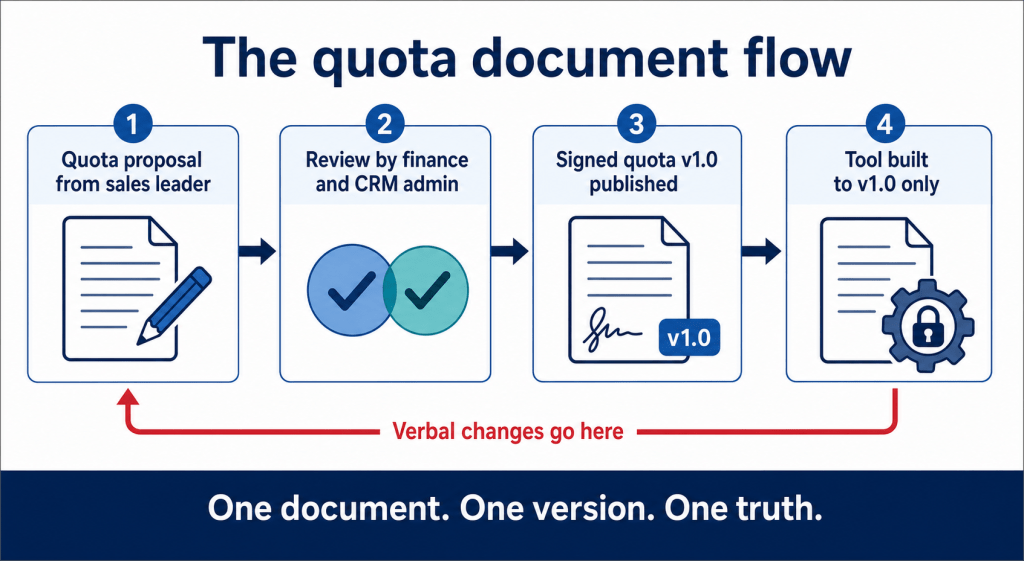
The channel plan on this deployment had a quota file that was superseded partway through the quarter by a set of verbal changes. The tool was built to the file. The verbal changes then had to be applied retroactively, and the difference between the two versions had to be reconciled.
Every quota in a commission program has to live in exactly one document, and that document has to have a version number, an effective date, and a signer. If a quota changes, the change is a new version of the document, not a message. The tool is built to the document, and only the document. Verbal changes are captured as a request to update the document, and the tool is not rebuilt until the document is updated. This one discipline eliminates a specific class of quarter-end surprise.
Lesson 12. Quota currency must be internally consistent
On this program, some quotas were originally set in one currency and some in another. When the team converted between the two using the agreed FX rates, the resulting values did not match the values the stakeholders expected. The mismatch was not a math error. It was a specification error: the stakeholders had set the quotas in local currency without agreeing on which local currency would be canonical, and when the tool applied the FX conversion, the round-trip did not preserve their intent.
The lesson is that a commission program has to pick one canonical quota currency per plan, and every rep on that plan has their quota expressed in that currency. Reps who sell in a different local currency have their deals converted to the canonical currency at the agreed FX rate before attainment is measured. The alternative, quotas in mixed currencies with conversions applied ad hoc, produces exactly the kind of quiet mismatch this deployment surfaced. For a broader treatment of multi-currency commission programs, see our multi-currency sales commissions piece.
What good looks like: a pre-build checklist
The twelve lessons collapse into a single pre-build checklist. If every item can be answered in one sentence with a named owner and a signed document, the deployment will run at least twice as fast as one where any item is deferred.
| Item | Key Question | Owner |
|---|---|---|
| Plan spec | Is there one signed brief with every rule and every exception in it? | Sales ops lead |
| FX rate source | Which table, on what date, for which purpose? | Finance lead |
| Quota currency | What is the canonical currency per plan? | Finance lead |
| Exceptions list | Which reps and deals do not follow the standard plan? | Sales ops lead |
| Role classifications | Is every rep and manager assigned to the correct plan family? | HR partner |
| Draw mechanics | Recoverable, release timing, termination, cadence? | Finance lead |
| Scorecard metrics | Does every metric have a one-sentence definition? | Sales ops lead |
| Caps and floors | Are all caps and floors written down and encoded in v1? | Sales ops lead |
| SDR data contract | Which CRM fields determine ownership, timing, disposition? | CRM admin |
| Quota document | Is there exactly one signed and versioned quota file? | Finance lead |
| Golden set | Has one historical quarter been reconciled against the tool? | Sales ops lead |
| Governance | Who signs off on plan changes, and how are they versioned? | Executive sponsor |
Why messy is normal, and streamlined is a choice
The message worth ending on is the one the field team put most plainly. Commissions are often messy, and that is normal. Every organization that pays commissions on more than a handful of reps runs into the twelve patterns above, usually more than once, and usually in combination. The presence of mess is not a sign that the program is broken or that the tool has failed. It is a sign that the program is real, that the business is complex, and that the rules that govern pay are being tested against actual deals for the first time.
The value of a good deployment is not that it eliminates the mess. It is that it makes the mess visible, forces every decision to be made once, and encodes each decision in a place where the rep, the manager, the finance analyst, and the auditor can all see the same answer. There will always be exceptions. There will always be edge cases. What changes is that a mature program handles them in one place, with one owner, on a documented cadence, instead of handling them in a private spreadsheet on the way to payroll. That is what streamlined actually means, and it is what a large deployment, done well, delivers.
Related reading
- Plan design principles for durable commission programs
- Draw against commission: mechanics and edge cases
- Quota accelerators: caps, floors, and structure
- Multi-currency sales commissions
- Preventing sales commission overpayments
- Shadow accounting in sales
- Manager override workflows
Sources
- Sales Cookie University: salescookie.com/University
- Sales Cookie support portal: support2.salescookie.com/portal/en/home
- Sales Cookie blog: blog.salescookie.com
- Anonymized field notes from a 2026 Sales Cookie deployment covering multiple countries, currencies, and plan families.

